AI can generate a landing page, write a sales email, summarize a call, or suggest campaign ideas in seconds.
But isolated outputs do not create a marketing and sales funnel.
A funnel works when every stage carries the same understanding of the customer:
- research identifies a real problem;
- positioning turns that problem into a relevant promise;
- the landing page explains the promise;
- the lead magnet provides an early result;
- nurture emails build trust;
- sales conversations address the right objections;
- follow-up reflects what the prospect actually said.
If these stages are created independently, the experience feels fragmented. An ad promises one thing, the landing page emphasizes another, and the sales email sounds as if it was written for a different audience.
The best use of AI is not generating more content. It is maintaining context across the complete customer journey.
This guide shows how to build an AI-powered marketing and sales funnel from research to follow-up. The workflow can be completed in Neurohelper, where research, reasoning, writing, image generation, presentation, audio, and other models are available within one subscription.
Complete workflow: Evidence → ideal customer profile → positioning → offer → landing page → lead magnet → nurture → sales conversation → follow-up → funnel improvement.
What is an AI-powered marketing and sales funnel?
An AI-powered funnel uses artificial intelligence to assist with analysis, content creation, personalization, sales preparation, and optimization across the customer journey.
AI may help with:
- organizing customer research;
- finding repeated problems in reviews;
- defining ideal customer profiles;
- comparing competitor messaging;
- generating positioning options;
- drafting landing-page copy;
- planning lead magnets;
- writing email sequences;
- preparing discovery questions;
- summarizing sales notes;
- drafting relevant follow-up;
- finding patterns in won and lost opportunities.
The funnel is not “automated” simply because AI appears in several steps.
A useful system still needs:
- reliable source material;
- human-approved positioning;
- real product evidence;
- clear ownership;
- quality control;
- privacy and compliance rules;
- measurable conversion events.
AI should make the team faster and more consistent. It should not invent customer evidence, impersonate prospects, fabricate personalization, or send unreviewed messages at scale.
Start with a funnel source package
Before prompting any model, assemble a compact source package.
Include:
- Product information: features, use cases, limitations, pricing, and onboarding.
- Customer evidence: interviews, reviews, support conversations, surveys, and sales notes.
- Audience data: roles, industries, company sizes, situations, and current alternatives.
- Competitor material: landing pages, pricing pages, public campaigns, and comparison pages.
- Proof: verified outcomes, case studies, demonstrations, testimonials, and product screenshots.
- Brand rules: tone, terminology, visual identity, required disclaimers, and prohibited claims.
- Funnel data: traffic sources, conversion rates, pipeline stages, common objections, and loss reasons.
- Commercial goal: trial, demo, lead, purchase, upgrade, or another measurable action.
Separate verified facts from assumptions.
For example:
Verified:
- Most trial users create their first project in under ten minutes.
- Customers can access multiple AI model providers under one subscription.
- The product supports text, image, video, and audio workflows.

Assumptions to validate:
- Agencies value subscription consolidation more than individual model access.
- Speed is a stronger purchase driver than experimentation.
- Teams understand the difference between model categories.
This distinction prevents a model from presenting an internal hypothesis as a customer fact.
Step 1: Turn raw research into customer insight
AI is useful for organizing large amounts of qualitative evidence.
Collect:
- interview transcripts;
- sales-call notes;
- customer reviews;
- support tickets;
- survey responses;
- public competitor reviews;
- community discussions;
- reasons for churn;
- reasons opportunities were lost.
Ask the model to preserve the original language customers use.
Customer research prompt
Act as a product marketing researcher.

Analyze the attached customer interviews, sales notes, reviews, and support
conversations.

Identify:
1. The most frequent customer situations.
2. The problems customers describe in their own words.
3. The consequences of leaving each problem unsolved.
4. The alternatives customers currently use.
5. The reasons they switch.
6. The objections that delay a purchase.
7. The evidence they consider credible.
8. Differences between customer segments.

For every insight:
- include supporting excerpts;
- identify the source;
- show how frequently the pattern appears;
- separate direct evidence from interpretation.

Do not invent percentages, quotes, customers, or conclusions.
The result should not be a generic list such as “customers want to save time.” It should reveal situations and tradeoffs.
Better insight:
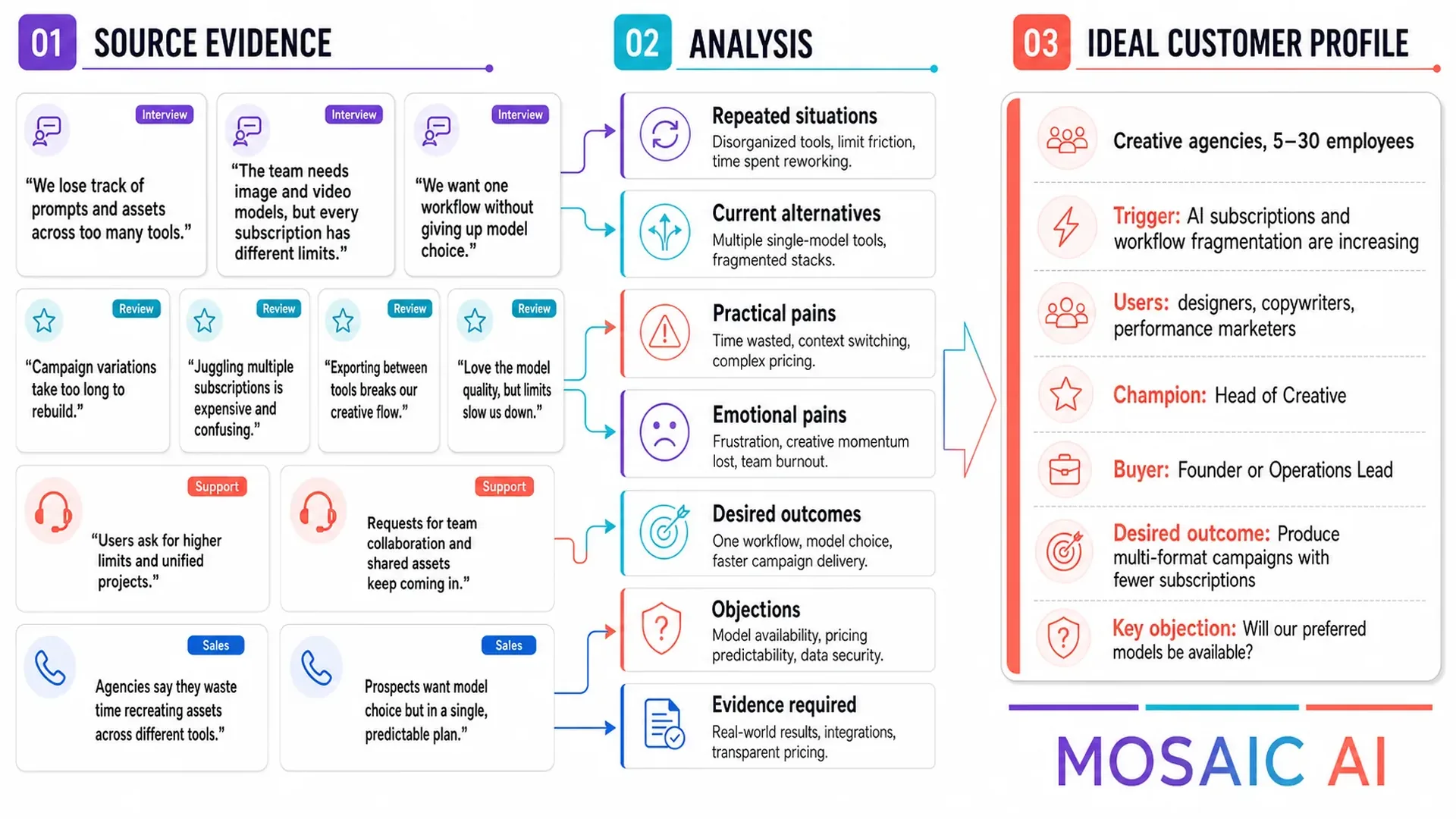
Small agency teams lose time moving briefs, prompts, and generated assets between several AI tools. They want fewer subscriptions, but they worry that a unified platform may not offer the models they already use.
This insight can inform messaging, proof, product education, and sales objections.
Step 2: Define the ideal customer profile
An ideal customer profile is not simply an industry and company size.
It should describe:
- the situation that creates urgency;
- the existing workflow;
- the cost of the current problem;
- the people affected;
- buying authority;
- required capabilities;
- potential objections;
- disqualifying conditions;
- signs that the product can create value.
For B2B products, distinguish the company profile from the people involved.
Example:
| Layer | Example |
|---|---|
| Company | Creative agency with 5–30 employees |
| Trigger | AI tool costs and workflow fragmentation are increasing |
| User | Designer, copywriter, performance marketer |
| Champion | Head of Creative or Marketing Lead |
| Buyer | Founder, Operations Lead, or Finance |
| Main outcome | Produce multi-format creative work with fewer subscriptions |
| Objection | Concern that preferred models will not be available |
| Disqualifier | Team needs a specialized enterprise workflow not currently supported |
Avoid creating ten overlapping personas. Begin with one or two commercially meaningful segments.
ICP prompt
Using only the supplied research, define the strongest ideal customer profile.

Include:
- company characteristics;
- triggering event;
- current workflow;
- measurable and emotional costs;
- end users;
- champion;
- economic buyer;
- desired outcome;
- required proof;
- top objections;
- disqualifying conditions;
- signals of high purchase intent.

For each field, cite the evidence that supports it.
Mark unsupported conclusions as hypotheses to validate.
Step 3: Build a positioning statement
Positioning answers four questions:
- Who is the product for?
- What important problem does it solve?
- What category or frame helps the customer understand it?
- Why should the customer believe this product is a better choice?
A reusable positioning structure:
For [specific audience]
who [high-value situation or problem],
[product] is a [category or frame]
that [primary outcome].
Unlike [current alternative],
it [meaningful difference],
supported by [credible proof].
Do not ask AI for fifty slogans before agreeing on positioning.
Slogans compress positioning; they do not replace it.
Generate three or four positioning directions and score them against:
- relevance;
- differentiation;
- credibility;
- clarity;
- evidence;
- fit with customer language.
Step 4: Create a messaging matrix
A messaging matrix keeps the landing page, ads, emails, and sales conversations aligned.
Build rows for:
- primary audience;
- problem;
- consequence;
- desired outcome;
- product mechanism;
- benefit;
- proof;
- objection;
- response;
- call to action.
Then create segment-specific columns.
Example:
| Message layer | Creative agency owner | Performance marketer |
|---|---|---|
| Problem | Too many AI subscriptions and disconnected workflows | Slow production of campaign variations |
| Desired outcome | Consolidate the creative stack | Test more concepts without losing consistency |
| Relevant capability | Multiple model providers in one subscription | Text, image, and video workflow in one product |
| Proof needed | Model catalog, pricing, workflow demonstration | Real campaign examples and iteration speed |
| Objection | “Will my team lose access to preferred models?” | “Will output remain consistent across formats?” |
Messaging matrix prompt
Using the approved research, ICP, and positioning, create a messaging matrix.

For each audience segment include:
- customer situation;
- problem in customer language;
- practical consequence;
- emotional consequence;
- desired outcome;
- product mechanism;
- primary benefit;
- supporting evidence;
- likely objection;
- honest response;
- recommended call to action.

Do not add claims that are absent from the source package.
Flag every message that requires additional proof.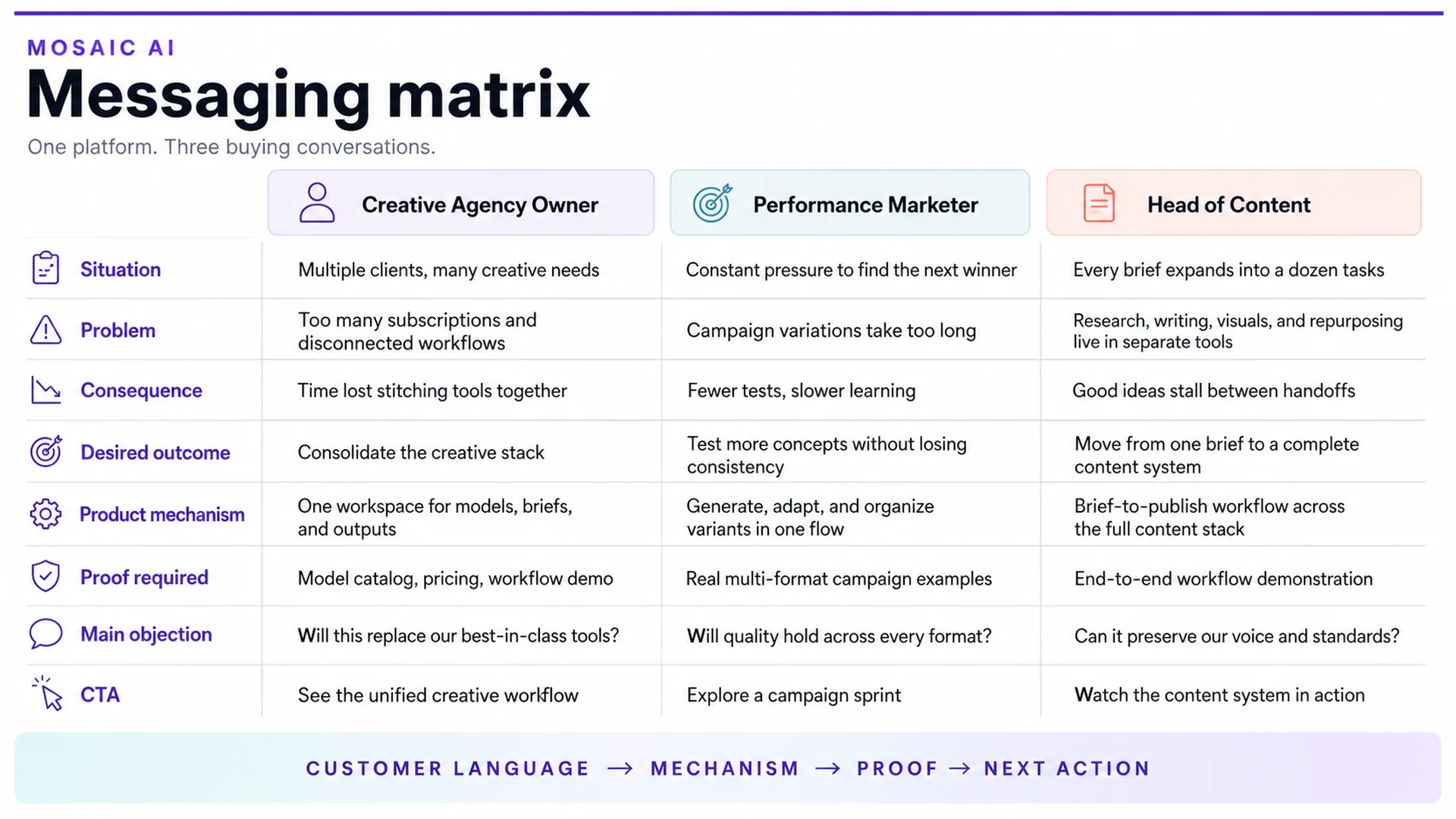
Step 5: Design the offer before the landing page
A landing page cannot repair an unclear offer.
Define:
- what the customer receives;
- who it is for;
- the first result they can expect;
- how quickly they can reach that result;
- the commitment required;
- pricing or entry condition;
- proof;
- risk reduction;
- next action.
Possible offers include:
- free trial;
- interactive demo;
- strategy call;
- product assessment;
- template pack;
- calculator;
- audit;
- workshop;
- limited starter plan.
The best offer depends on purchase complexity.
A low-cost self-service product may send visitors directly to signup. A higher-consideration B2B service may need a useful diagnostic or demo before a sales conversation.
Step 6: Build the landing page around decision questions
Instead of filling a standard template, answer the visitor's questions in order:
- Is this relevant to me?
- What outcome can I achieve?
- How does it work?
- Why is it different?
- Can I trust it?
- Will it fit my situation?
- What will happen after I click?
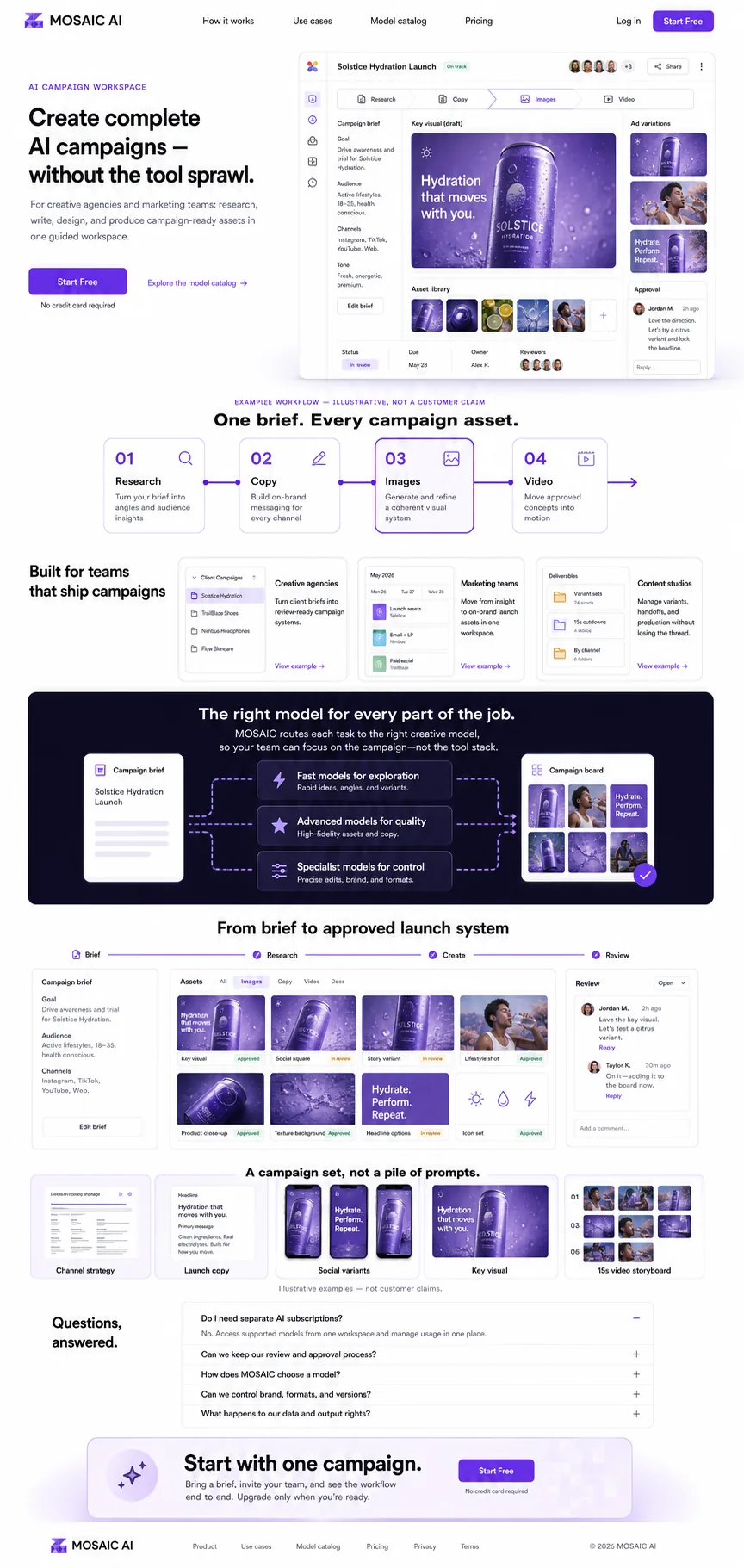
A practical landing-page structure:
- clear outcome-focused hero;
- audience or situation;
- problem and current friction;
- product mechanism;
- workflow or demonstration;
- benefits;
- proof;
- use cases;
- objection handling;
- final call to action.
Landing-page prompt
Write a landing-page outline using the approved positioning and messaging matrix.

Goal:
[signup, demo, lead, purchase]

Audience:
[approved ICP]

For each section provide:
- purpose;
- headline;
- supporting copy;
- required proof or visual;
- call to action;
- objection addressed.

Use specific customer language.
Do not invent statistics, testimonials, logos, ratings, or guarantees.
Mark every missing proof element as [PROOF NEEDED].
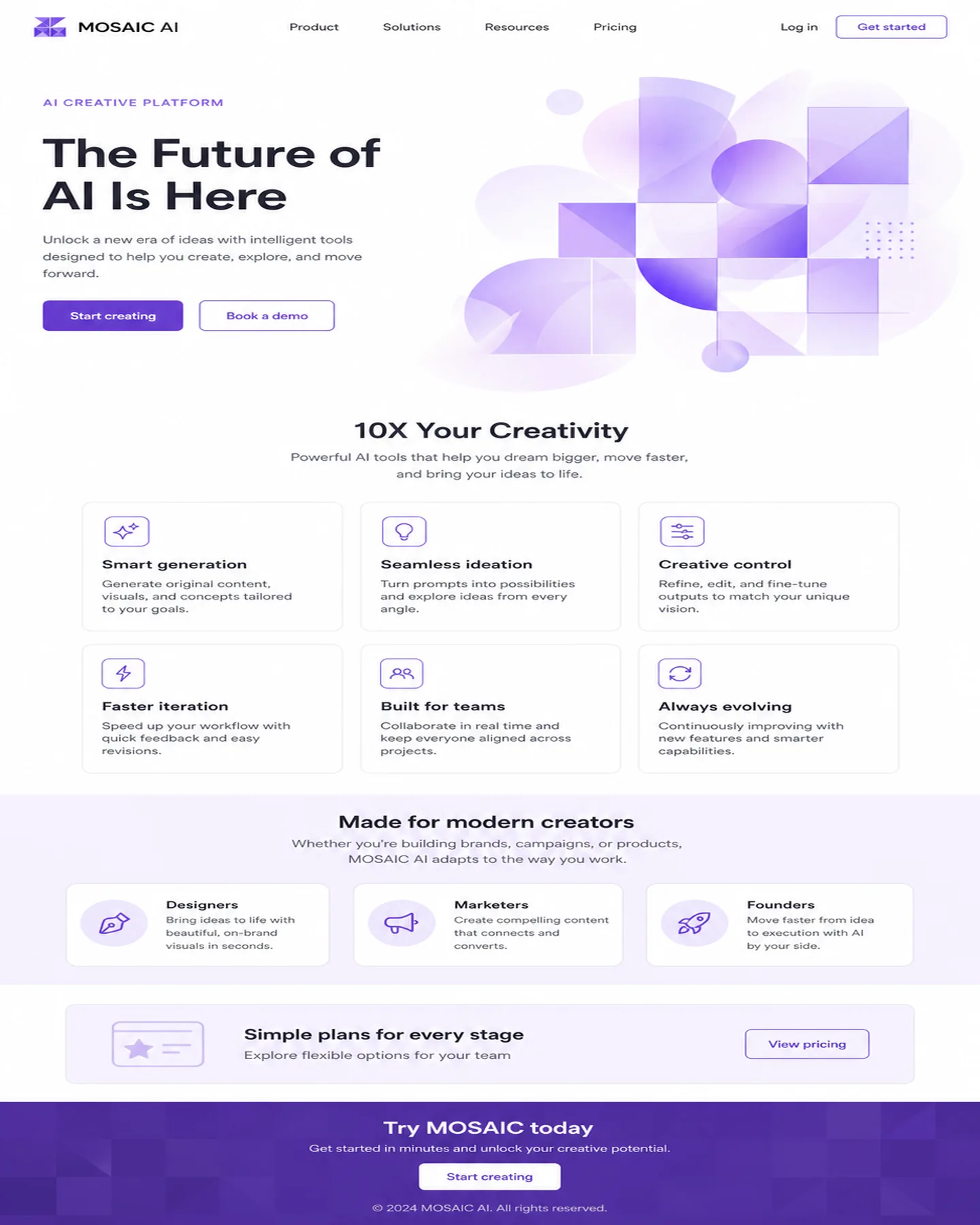
After drafting, ask another model to challenge the page:
- Which claims are vague?
- What questions remain unanswered?
- Where does the copy require proof?
- Does the CTA match the visitor's readiness?
- Is the page explaining features before relevance?
- Does each section move the decision forward?
Step 7: Create a lead magnet that produces a small result
A lead magnet should not be a long document created only to collect an email address.
It should help the prospect make progress.
Strong formats include:
- calculator;
- checklist;
- audit template;
- benchmark;
- prompt pack;
- planning worksheet;
- decision guide;
- mini-course;
- teardown;
- interactive assessment.
Connect the lead magnet to the paid outcome.
For example:
| Paid outcome | Useful lead magnet |
|---|---|
| Improve campaign production | Creative workflow audit |
| Consolidate AI tools | AI subscription cost calculator |
| Increase landing-page conversion | Conversion friction checklist |
| Improve outbound sales | Account research template |
| Build consistent content | Multi-format campaign planning sheet |
The lead magnet should reveal the need for the product naturally, not manufacture anxiety.
Lead-magnet prompt
Design a practical lead magnet for the approved ICP.

Customer situation:
[situation]

Paid outcome:
[outcome]

Create:
1. A specific title.
2. The immediate result the user will obtain.
3. A five-part structure.
4. Questions, calculations, or exercises.
5. A useful final output.
6. A natural bridge to the product.
7. A landing-page summary.
8. A delivery email.

Avoid generic advice and unsupported benchmarks.
The lead magnet must provide value even if the reader does not purchase.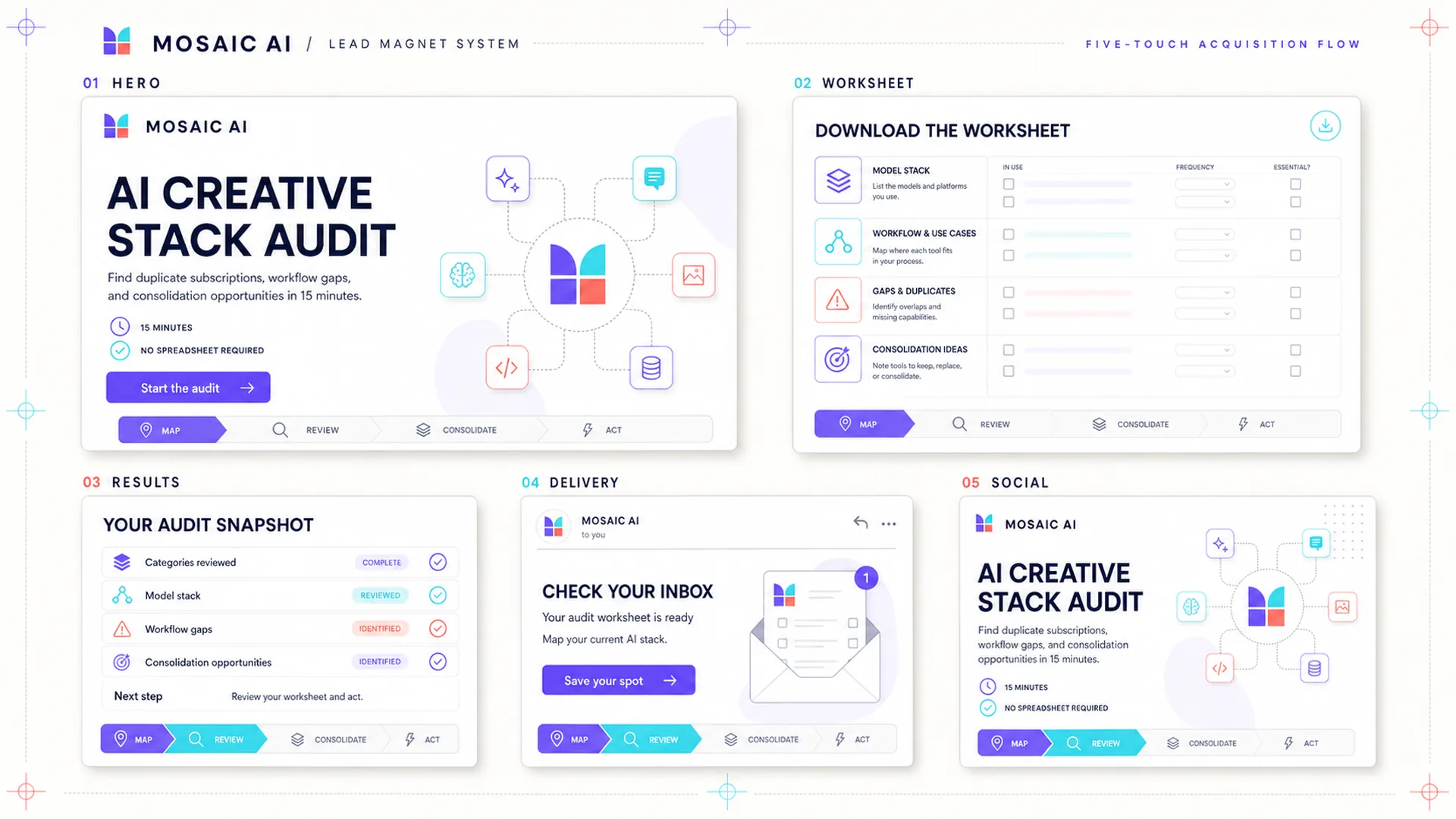
Step 8: Write a nurture sequence based on readiness
Not every lead is ready for a sales conversation.
A nurture sequence should help the prospect:
- understand the problem;
- evaluate alternatives;
- see proof;
- address risk;
- take the next appropriate action.
A simple five-email sequence:
- Deliver the resource: provide the promised asset and explain how to use it.
- Interpret the result: show what different outcomes mean.
- Teach a useful method: help the reader solve part of the problem.
- Provide evidence: share a verified example, demonstration, or case study.
- Offer the next step: invite a trial, demo, assessment, or conversation.
Avoid fake urgency and repetitive “just checking in” emails.
Nurture sequence prompt
Create a five-email nurture sequence for leads who downloaded [resource].

Use:
- the approved ICP;
- the positioning statement;
- the messaging matrix;
- verified product evidence;
- the reader's likely stage of awareness.

For each email provide:
- purpose;
- subject line;
- preview text;
- concise body;
- one call to action;
- the objection or question addressed.

Do not invent personalization, customer results, urgency, or scarcity.
Each email must add new value rather than repeat the previous message.
Step 9: Prepare sales outreach responsibly
AI can help a salesperson understand an account and write a relevant first draft.
It should not produce mass messages that pretend to be personally researched.
Use only appropriate business information and respect applicable privacy, consent, and outreach rules.
For account research, gather:
- company website;
- public product information;
- recent public announcements;
- open roles;
- public interviews;
- relevant technology or workflow signals;
- previous interactions stored with permission.
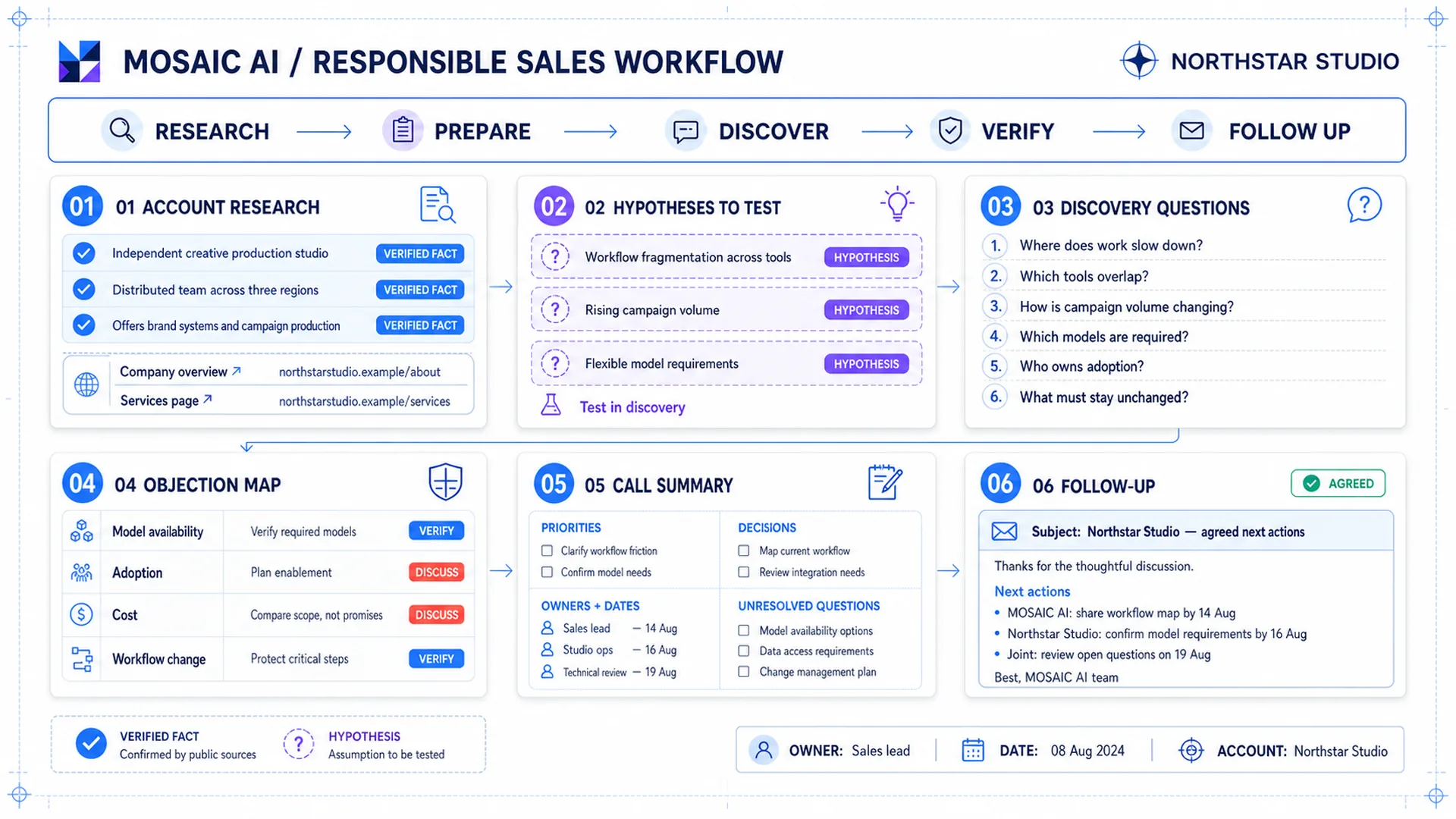
Then ask AI to separate facts from hypotheses.
Account research prompt
Prepare an account brief using only the supplied public and first-party sources.

Include:
- company summary;
- relevant business priorities;
- observable trigger events;
- likely workflow related to our product;
- evidence-backed reasons the account may be relevant;
- open questions;
- possible stakeholders;
- risks and disqualifiers.

For every statement, identify the source.
Label uncertain interpretations as hypotheses.
Do not infer sensitive personal information.
Personalization should explain why the conversation may be useful. It should not merely insert a company name into a generic template.
Step 10: Prepare for the sales conversation
AI can turn research and CRM context into a focused call plan.
A useful plan includes:
- what is known;
- what remains uncertain;
- likely participants;
- desired outcome;
- discovery questions;
- relevant proof;
- objections to explore;
- next-step options.
Discovery-call preparation prompt
Create a discovery-call plan using the account brief, prior correspondence,
and approved ICP.

Separate:
1. Verified facts.
2. Hypotheses to test.
3. Missing information.

Prepare:
- a concise opening;
- eight prioritized discovery questions;
- follow-up questions for likely answers;
- relevant product examples;
- objections that may arise;
- evidence we can use;
- signals that the opportunity is not a fit;
- possible next steps.

Do not script a manipulative conversation.
The goal is to understand the customer's situation and determine fit.
Step 11: Turn call notes into relevant follow-up
After the call, provide the model with an approved transcript or notes.
Ask it to extract:
- participants;
- current situation;
- priorities;
- problems;
- desired outcomes;
- decision criteria;
- objections;
- commitments;
- owners;
- dates;
- unresolved questions;
- next step.
Then draft a follow-up that reflects the actual conversation.
Draft a concise follow-up email using only the attached call notes.

Include:
- a brief thank-you;
- the customer's priorities in their language;
- agreed next steps;
- owner and date for each action;
- requested resources;
- unresolved questions.

Do not add commitments, claims, deadlines, or product capabilities that were
not discussed.
Do not say “great call” or “just checking in.”
The salesperson should review the email before sending it.
Step 12: Build feedback from sales back into marketing
Marketing and sales should not use separate versions of the customer.
Create a recurring review of:
- objections raised;
- questions prospects ask;
- proof requested;
- features misunderstood;
- competitors mentioned;
- reasons deals progress;
- reasons deals stall;
- reasons deals are lost;
- content used during successful opportunities.
AI can cluster the notes, but a person should validate the conclusions.
Possible outputs:
- updated FAQ;
- new comparison page;
- clearer pricing explanation;
- objection-handling content;
- new case study;
- revised qualification criteria;
- product education;
- landing-page changes.
The funnel becomes stronger when customer conversations change the marketing system.
How to choose models for each funnel stage
Different tasks benefit from different model strengths.
| Funnel task | Useful model capability |
|---|---|
| Research synthesis | Long-context analysis and source discipline |
| Positioning | Reasoning, structured comparison, critical feedback |
| Landing-page copy | Clear writing and audience adaptation |
| Visual concepts | Image generation and image editing |
| Lead magnet | Structured writing, design planning, document creation |
| Sales preparation | Summarization, question generation, evidence separation |
| Follow-up | Precise writing grounded in call notes |
| Funnel review | Pattern detection across structured records |
In Neurohelper, you can use GPT 5.6 Luna Pro or Terra Pro for everyday analysis and drafting, GPT 5.6 Sol Pro for more demanding strategic work, compare Claude, Gemini, Qwen, DeepSeek, and other text models, and continue into image generation with GPT Image 2, Nano Banana 2, Nano Banana Pro, Flux 2, Grok Imagine Image, or other supported models.
The goal is not to select one universal model. It is to use the appropriate model for each stage while keeping the approved source package consistent.
Common mistakes
Generating before researching
The result sounds polished but generic because the model has no real customer evidence.
Treating personas as fiction-writing
Invented motivations create convincing documents that do not represent actual buyers.
Asking for too many messages
Fifty headlines are not useful when the positioning remains unclear.
Allowing AI to invent proof
Never publish generated testimonials, customer logos, statistics, certifications, or outcomes.
Automating outreach without review
High message volume cannot compensate for weak relevance and may damage trust or violate outreach rules.
Using call summaries as perfect records
Names, numbers, commitments, and dates require verification.
Optimizing only the top of the funnel
More leads do not help when qualification, onboarding, or follow-up is broken.
Ignoring sales feedback
Repeated objections are valuable product-marketing evidence.
Funnel measurement checklist
Choose a small number of metrics for each stage.
Acquisition
- qualified traffic;
- campaign click-through rate;
- cost per relevant visitor;
- landing-page engagement.
Conversion
- form completion;
- signup or demo rate;
- lead-magnet completion;
- activation rate.
Nurture
- meaningful email engagement;
- resource usage;
- return visits;
- transition to the next step.
Sales
- qualified opportunity rate;
- meeting-to-opportunity conversion;
- stage progression;
- time in stage;
- objection patterns;
- win and loss reasons.
Revenue
- customer acquisition cost;
- conversion to paid;
- sales-cycle length;
- retention;
- expansion.
Do not optimize an AI-generated asset only because it is faster to produce. Measure whether it improves customer understanding and commercial outcomes.
Final workflow
The complete AI marketing and sales funnel looks like this:
- collect reliable customer and product evidence;
- synthesize customer situations and pains;
- define the ICP and buying roles;
- approve positioning;
- build a shared messaging matrix;
- define the offer;
- create and challenge the landing page;
- build a useful lead magnet;
- nurture leads according to readiness;
- research accounts responsibly;
- prepare discovery conversations;
- create accurate follow-up;
- return sales insight to marketing;
- measure conversion and revenue outcomes.
AI accelerates every stage, but context and evidence connect the system.
Frequently asked questions
How can AI improve a sales funnel?
AI can organize research, identify customer patterns, develop messaging, draft landing pages and emails, prepare sales calls, summarize notes, and help analyze funnel feedback. The quality depends on reliable source material and human review.
Can AI generate leads?
AI can help create lead magnets, identify relevant account signals, improve conversion content, and draft outreach. It should not be used to invent prospect data or send misleading mass personalization.
What is the best AI tool for sales and marketing?
There is no single best model for every stage. Research synthesis, strategic reasoning, copywriting, image generation, and call summarization may benefit from different models. Neurohelper makes it possible to compare several options under one subscription.
Can AI write cold sales emails?
Yes, but the message should use legitimate business context, provide a relevant reason for contact, comply with applicable rules, and be reviewed before sending. AI should not fabricate personal research or urgency.
How do I use AI for landing-page conversion?
Give the model customer research, positioning, proof, objections, and the conversion goal. Ask it to map every section to a visitor question and mark unsupported claims as requiring proof.
Can AI summarize sales calls?
Yes, when recordings or notes are processed with appropriate permission and privacy safeguards. Verify names, numbers, dates, commitments, and next steps before saving the summary.
What should I automate first?
Start with low-risk assistance: research organization, message variations, meeting preparation, content outlines, and draft summaries. Add automation only after the underlying process and quality controls are clear.
Is Neurohelper useful for both marketing and sales?
Yes. Teams can use text models for research, positioning, copy, sales preparation, and follow-up, then use image and other creative models for campaign assets—all within the same subscription.