

AI can make research dramatically faster.
It can also make weak research sound unusually confident.
That tension defines the right way to use AI for research.
An AI research assistant can help narrow a question, generate search terms, organize sources, extract comparable evidence, identify contradictions, analyze interview notes, draft a literature-review structure, and turn verified findings into a report, diagram, presentation, or narrated explainer.
It should not invent citations, hide uncertainty, replace primary sources, or make a consequential decision simply because the answer sounds polished.
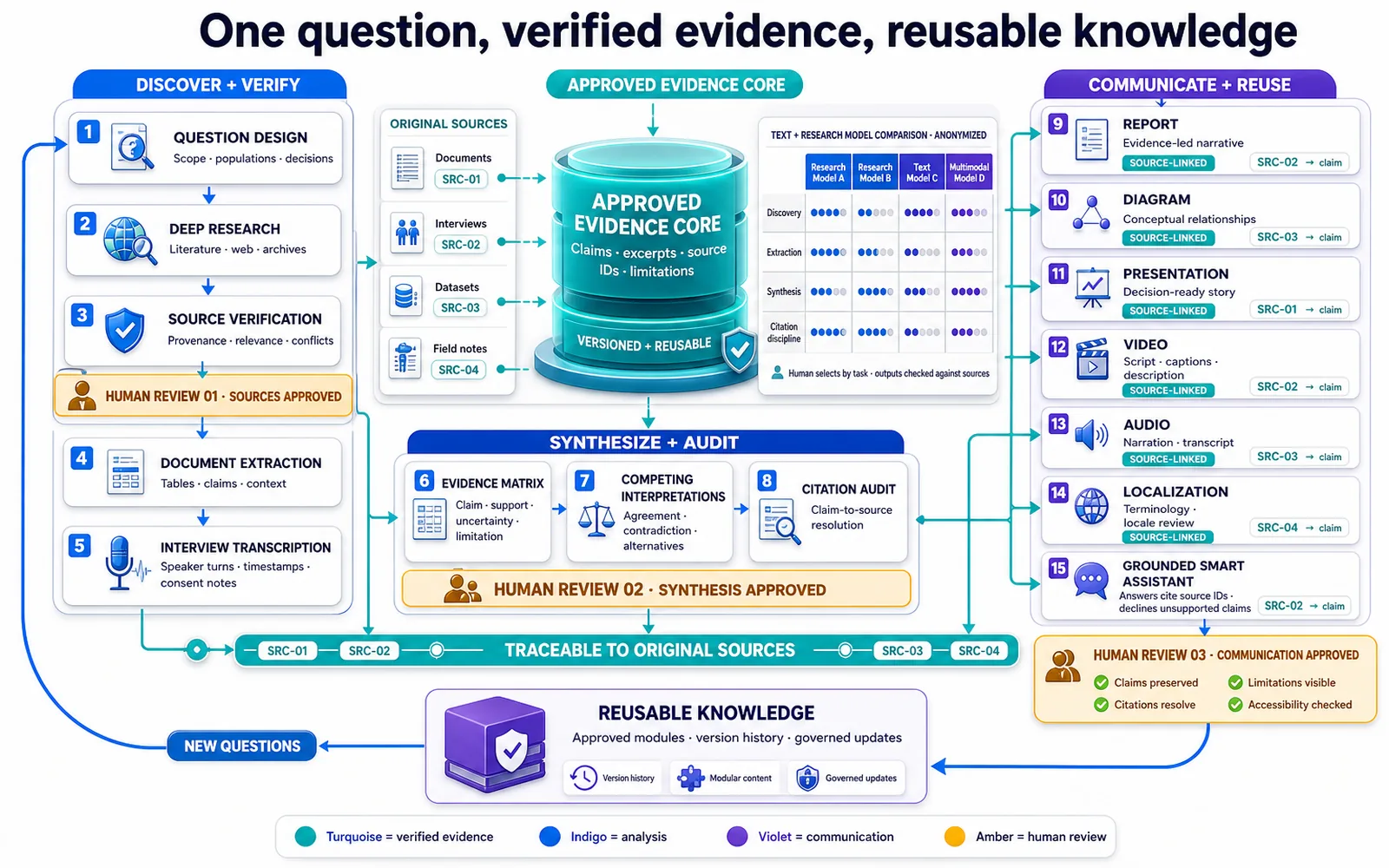
The strongest workflow is not “ask AI and copy the response.” It is:
- define the question;
- establish the scope and evidence criteria;
- discover and verify sources;
- extract information with traceability;
- compare and synthesize findings;
- separate evidence from interpretation;
- review the conclusion;
- communicate it for the intended audience.
This guide covers 40 practical AI use cases for academic, market, product, business, and content research. It also shows how Neurohelper can connect leading research and reasoning models with Chat Master, Image Master, Video Master, Audio Master, Smart Assistants, and reusable Workflows.
What is AI-assisted research?
AI-assisted research is the use of artificial intelligence to support one or more stages of a research process while keeping sources, methods, uncertainty, and human responsibility visible.
The assistance may be simple:
- rewriting a broad topic as a focused question;
- generating synonyms for a search query;
- summarizing a document supplied by the researcher;
- extracting the same fields from multiple sources;
- grouping interview statements into themes;
- preparing a report outline.
Or it may connect several stages:
- a deep-research model discovers candidate sources;
- Chat Master creates an evidence matrix;
- another leading model challenges the emerging conclusion;
- Image Master turns a reviewed concept into a clear explanatory diagram;
- Video Master and Audio Master produce an accessible explainer;
- a Smart Assistant answers follow-up questions from the approved source collection.
Neurohelper is useful here because research rarely ends with a chat response. Findings must be compared, explained, visualized, localized, presented, updated, and turned into action.
The evidence-first rule
Every important research output should preserve a visible path from conclusion back to source.
| Layer | What it contains |
|---|---|
| Source | The original paper, dataset, interview, document, standard, or primary webpage |
| Extraction | The relevant claim, method, quotation, figure, date, limitation, or observation |
| Comparison | Agreements, contradictions, differences in scope, and missing evidence |
| Interpretation | What the researcher believes the evidence may mean |
| Decision | What action is taken, by whom, and with what remaining uncertainty |
AI can assist at every layer, but it should not blur them together.
If a model produces a source, open it. If it provides a quotation, find the exact passage. If it reports a number, verify the unit, population, period, methodology, and original table. If the source cannot be confirmed, do not present the claim as verified.
40 practical AI research use cases
Research planning and question design
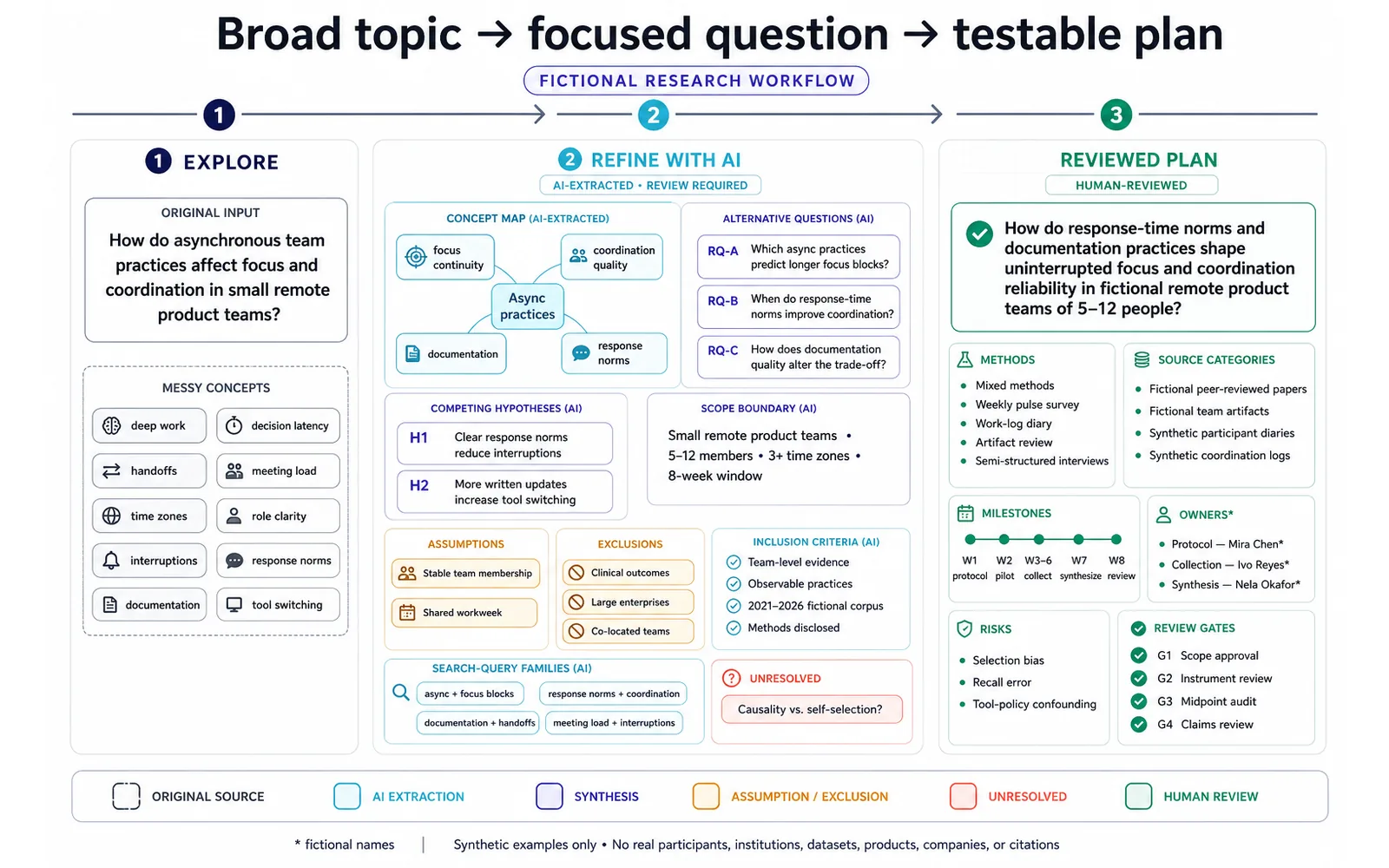
1. Turn a broad topic into a focused research question
“AI in education” is a topic, not a research question.
Ask Chat Master to narrow the topic by population, context, outcome, geography, period, intervention, comparison, and available evidence. It might produce different forms: descriptive, comparative, causal, exploratory, or decision-oriented.
The researcher chooses the question based on purpose and feasibility. The model helps reveal how many different questions were hidden inside the original phrase.
2. Define scope and exclusions
A useful research plan says what will not be included.
AI can help define time range, geography, language, population, source type, publication status, product category, market segment, and excluded topics. Ask it to identify where each boundary may bias the result.
Explicit exclusions prevent the scope from expanding whenever a new source appears.
3. Build a concept map and working glossary
Complex fields often use several terms for similar ideas or the same term for different ideas.
Chat Master can create a concept map containing core terms, related concepts, broader and narrower categories, synonyms, acronyms, and disputed definitions. Verify specialist definitions using authoritative sources.
The glossary improves search queries, source comparison, interview questions, and consistency across the final report.
4. Surface assumptions and competing hypotheses
Before searching for evidence, ask AI to list what the current framing assumes.
Then request alternative explanations and evidence that would support or weaken each one. This is useful when a team already prefers a solution and may interpret every source in its favor.
The goal is not to generate endless skepticism. It is to make confirmation bias easier to notice.
5. Create a research plan
Provide the question, intended audience, deadline, available data, required confidence, constraints, and decision the research should support.
AI can draft stages, deliverables, owners, dependencies, review points, and a realistic sequence. It can also distinguish quick directional research from a rigorous academic, legal, medical, financial, or technical investigation.
6. Define source inclusion and exclusion criteria
For a literature review or structured market scan, AI can help create explicit criteria before sources are evaluated.
Criteria may include publication type, methodology, sample, date, geography, language, relevance, authority, and whether the full source is accessible. Apply the rules consistently and record why sources were excluded.
7. Generate search strategies and query variants
Give Chat Master the concept map and ask for query families containing synonyms, related terms, exclusions, Boolean combinations, and database-specific variants.
For example, product research may require separate queries for customer language, competitor positioning, technical alternatives, pricing, reviews, and implementation concerns.
Search suggestions are starting points. The researcher still selects appropriate databases and reviews results.
8. Draft interview or survey questions
AI can turn a research objective into neutral, open-ended interview questions, probes, sequence, and interviewer notes.
Ask it to flag leading, double-barreled, ambiguous, or overly sensitive questions. For surveys, request response-option checks, missing categories, and an estimate of completion burden.
Human review is essential for ethics, consent, privacy, sampling, and domain appropriateness.
Source discovery and evaluation
9. Map the source landscape
Ask AI what types of evidence could answer the question: peer-reviewed studies, datasets, official statistics, standards, patents, company filings, technical documentation, interviews, surveys, reviews, archives, or expert commentary.
This prevents an entire investigation from relying on whichever pages are easiest to find. The map should identify likely primary sources and access limitations.
10. Discover candidate sources with deep research
Deep-research models can search across many pages and produce a sourced overview faster than manual browsing alone.
Use the output as a discovery layer. Open the cited pages, confirm that they support the associated claim, record publication and event dates, and prefer primary sources when available.
For model-specific guidance, see the Perplexity Sonar Deep Research guide.
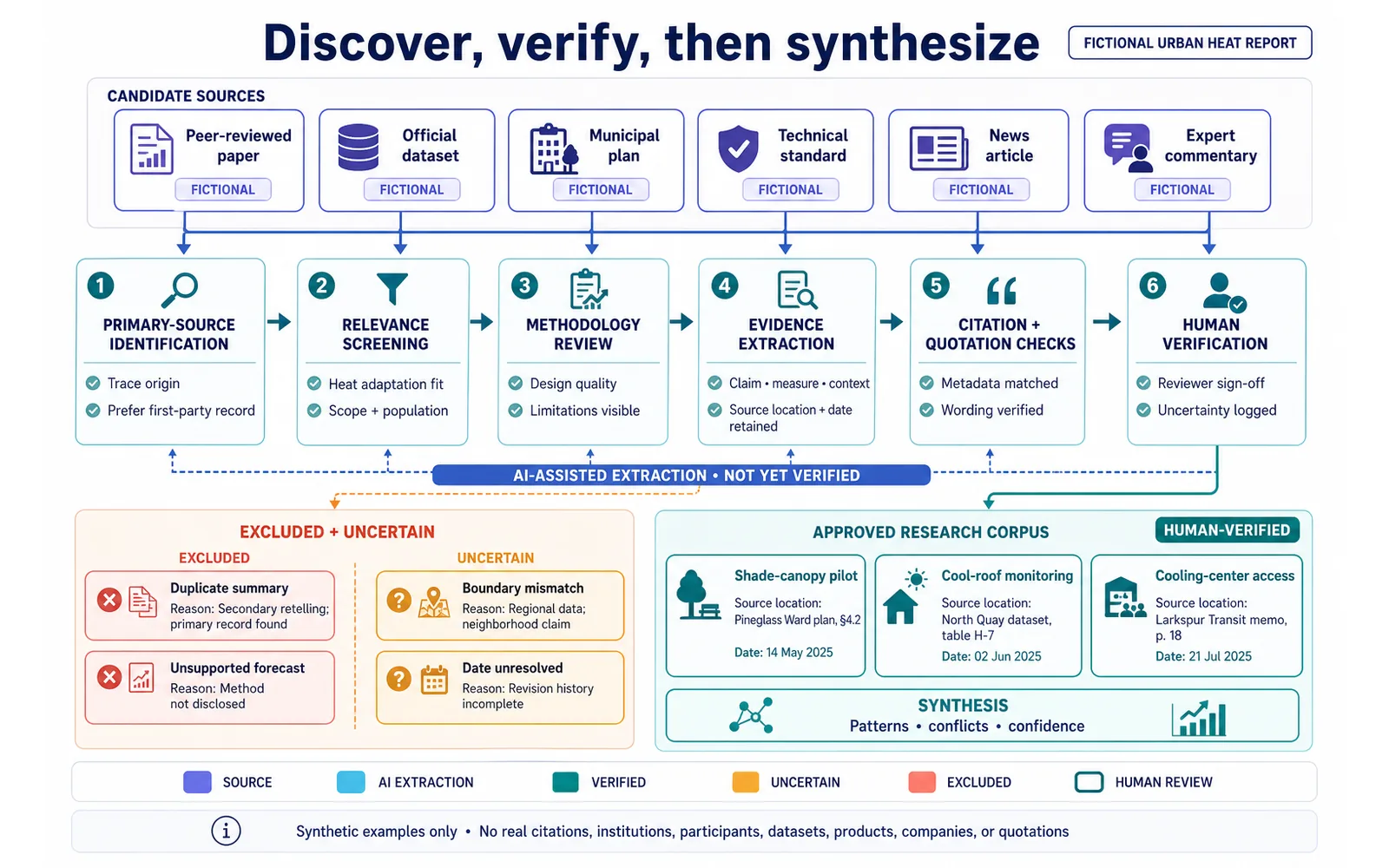
11. Separate primary, secondary, and commentary sources
AI can classify a source collection by evidence type.
A company announcement about its own release is a primary source for what the company announced, but not independent evidence that the product is the best. A news article may summarize an event accurately while still depending on another original document.
Classification makes the role of each source explicit.
12. Triage sources for relevance
When hundreds of titles and abstracts are available, AI can help screen them against predefined criteria.
The output should contain include, exclude, and uncertain categories with a short reason. Researchers should manually review ambiguous and high-impact items and measure whether the model is excluding relevant work.
13. Evaluate authority and methodology
Provide the full source or verified metadata. Ask AI to extract author or institution, purpose, methodology, population, sample, comparison, funding, date, limitations, and what the source can and cannot establish.
This is a structured reading aid, not an automatic quality score. Domain experts must judge whether the method fits the claim.
14. Summarize individual papers and reports
A useful research summary contains the question, method, evidence, result, limitations, and relevance to your own question.
Ask the model to cite page, section, table, or figure locations wherever possible. Do not rely on an abstract when the conclusion depends on details in the full text.
15. Extract comparable evidence fields
AI can extract the same fields from multiple sources into a table: publication date, sample, context, method, intervention, metric, result, uncertainty, limitation, and source location.
Structured extraction makes comparison faster and exposes missing information. Check critical fields against the original source, especially numbers, units, and negative results.
16. Create an annotated bibliography
For each source, generate a concise annotation containing relevance, main contribution, method, limitations, relationship to other sources, and potential use in the final work.
Include a stable link or identifier and the date accessed where appropriate. An annotation should help the researcher decide when to return to the source.
17. Follow citation trails
AI can identify foundational references cited by several papers, later work that builds on them, and references that appear to challenge the dominant interpretation.
Verify every bibliographic record. Models may produce plausible but nonexistent citations, merge titles, or misstate authors and dates.
18. Fact-check a specific claim
Break the claim into testable components: who, what, where, when, quantity, comparison, and source of authority.
Ask AI to identify the best primary evidence for each component and to distinguish verified, unsupported, misleading, outdated, and unresolved elements. A fact-check should show its evidence, not only return a true-or-false label.
Evidence analysis and synthesis
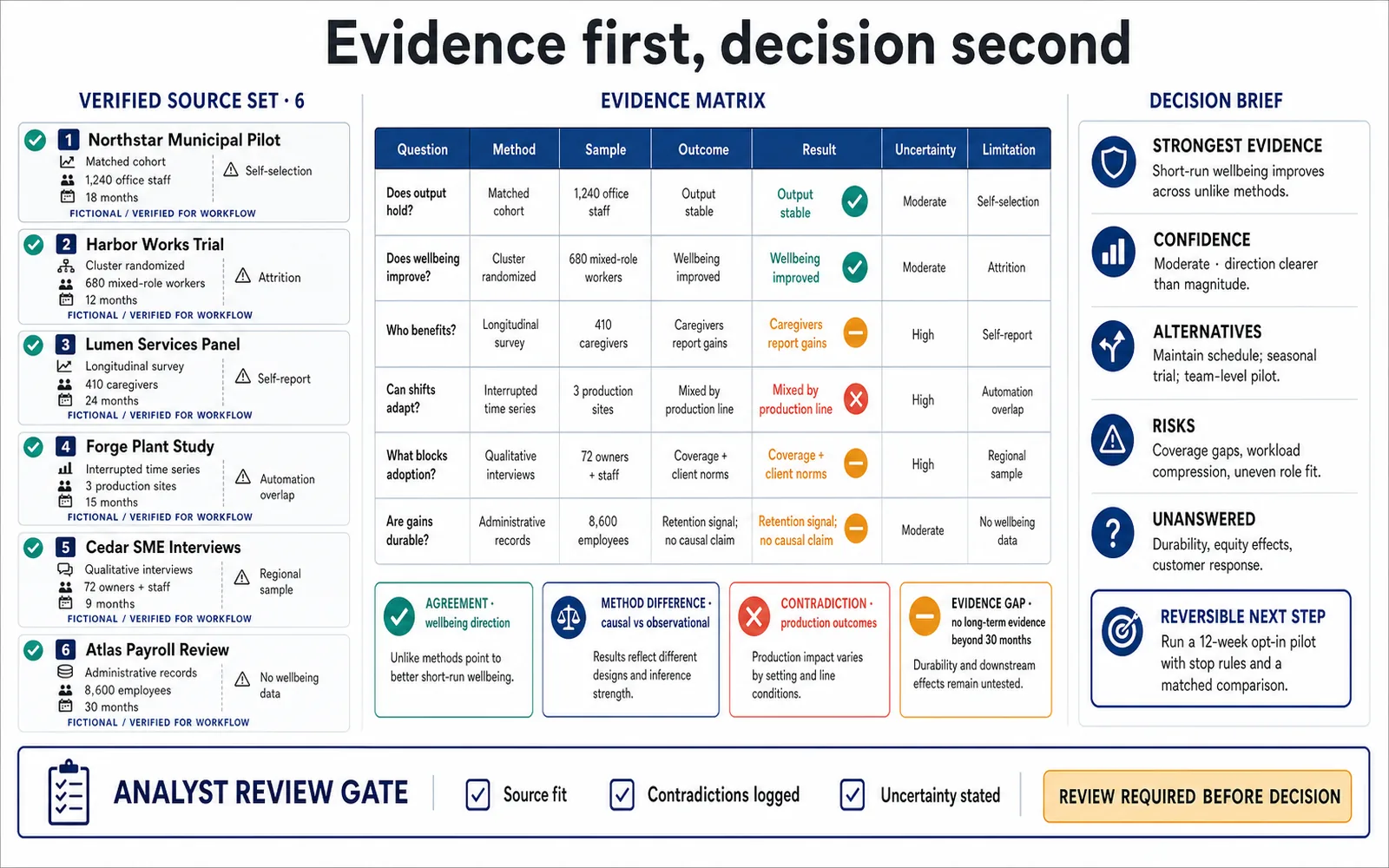
19. Build an evidence matrix
An evidence matrix places sources in rows and comparable claims, methods, populations, outcomes, and limitations in columns.
AI can populate a first draft from verified extractions and flag empty fields. The matrix makes it easier to see whether several articles repeat one original source or provide genuinely independent evidence.
20. Draft a literature-review structure
Instead of summarizing papers one after another, ask AI to group them by theme, method, chronology, school of thought, or point of disagreement.
The outline should explain relationships between sources and identify evidence gaps. Academic authors remain responsible for the argument, source selection, citations, and compliance with institutional policies.
For study planning, explanations, active recall, and other learning workflows, explore AI Education Use Cases.
21. Analyze qualitative interviews
AI can help code safely prepared transcripts, group excerpts into themes, compare participant types, and surface contradictory experiences.
Keep links from every theme to original excerpts. Review whether the model has erased minority views, overgeneralized memorable statements, or treated interviewer language as participant evidence.
22. Analyze open-ended survey responses
For a large collection of comments, AI can propose a coding scheme, classify responses, identify recurring issues, and select representative excerpts.
Validate the categories on a sample and protect personal data. Frequency does not automatically equal importance; a rare issue may still be severe.
23. Compare research methodologies
AI can explain how experimental, observational, qualitative, survey, case-study, simulation, benchmark, and mixed-method approaches answer different questions.
Use this to understand why two sources may reach different conclusions without assuming one must be fraudulent or incompetent.
24. Support structured-review screening
AI can assist with title, abstract, and full-text screening against predefined criteria, deduplication suggestions, and reason coding.
It should not silently decide the final corpus. Use duplicate review, disagreement resolution, recorded criteria, and method-specific standards when conducting a formal systematic or scoping review.
25. Analyze verified tabular data
Chat Master can help explain columns, propose calculations, identify missing values, suggest segmentations, and interpret a table you provide.
Use deterministic spreadsheet, statistical, or programming tools for calculations that must be exact. Verify formulas, denominators, filters, units, and transformations before interpreting the result.
26. Build timelines and trace change
AI can organize events, publications, product releases, policy changes, decisions, or scientific developments by date.
Record both publication date and event date when they differ. A timeline helps distinguish what participants knew at each moment and prevents later information from being projected backward.
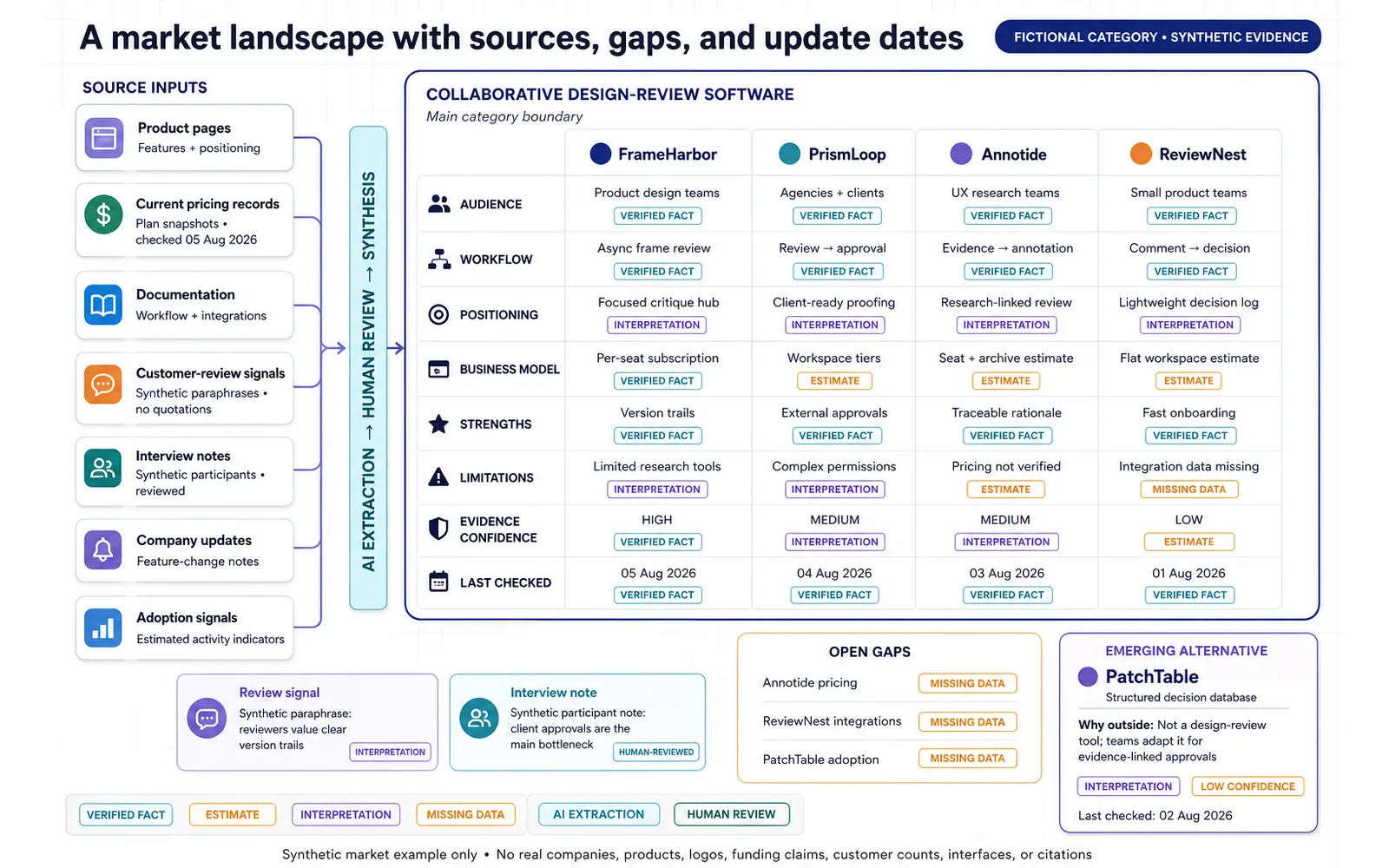
27. Create a market or competitor landscape
Combine verified product pages, pricing, documentation, customer reviews, funding announcements, job posts, and interviews.
AI can group competitors by audience, problem, workflow, business model, capability, maturity, and positioning. Use current primary sources for changing information and label estimates as estimates.
For turning market evidence into operational decisions, explore AI for Business: 30 Practical Use Cases.
28. Map standards, patents, or regulatory material
AI can organize titles, jurisdictions, dates, status, scope, definitions, requirements, and relationships across complex documents.
This helps navigate the landscape but is not legal advice, freedom-to-operate analysis, or compliance certification. Verify current official texts and involve qualified professionals where consequences are material.
29. Identify gaps and unanswered questions
Ask AI to compare the research question with the evidence matrix and list what remains unknown.
Useful gaps include missing populations, limited geography, outdated data, inconsistent definitions, weak comparisons, absent long-term outcomes, and questions for which only commentary exists.
30. Compare competing interpretations
Provide the same verified evidence and ask several leading models to construct the strongest plausible interpretations.
Then compare which evidence each interpretation uses, ignores, or requires. This is more useful than asking models to vote on the answer.
31. Create a decision brief with uncertainty
Turn the verified synthesis into a concise brief containing the decision, evidence, confidence, alternatives, risks, unknowns, reversible next step, and what new information could change the recommendation.
The final decision belongs to the accountable person or team.
Research writing and communication
32. Build an argument map before drafting
Ask AI to organize the central claim, supporting claims, evidence, counterarguments, limitations, and logical dependencies.
An argument map reveals when a polished conclusion rests on one weak assumption. It also separates what the sources establish from what the author infers.
33. Create a research-report outline
Provide the question, audience, method, evidence matrix, and intended decision.
AI can create a structure for an academic paper, market report, product-research readout, policy memo, technical investigation, or editorial feature. The outline should match the audience without omitting uncertainty.
34. Draft an executive summary
An executive summary should state why the question matters, what evidence was used, the main finding, confidence, limitations, and required action.
Ask for one-minute, one-page, and detailed versions. Compare every sentence with the full report so compression does not turn a qualified finding into an absolute claim.
35. Audit citations and unsupported claims
AI can mark sentences that contain factual claims, check whether each has a supporting citation in the supplied source set, and flag citations that appear unrelated or incomplete.
It cannot guarantee bibliographic correctness. Open the cited source and confirm the exact support before publication.
36. Create diagrams and conceptual visuals
Image Master can turn an approved framework, process, taxonomy, timeline, or relationship map into a clear editorial visual.
Do not use generative images for precise statistical charts or scientific figures that must reproduce exact data. Create those with deterministic tools and verify labels, scales, units, and values.
37. Build a research presentation
AI can adapt a report into a presentation containing the question, method, strongest evidence, contradictions, implications, limitations, and next step.
Use visual hierarchy rather than copying paragraphs onto slides. Prepare an appendix with source details for questions.
38. Produce an accessible explainer
Chat Master can rewrite findings for a non-specialist audience without removing essential caveats. Image Master can add explanatory visuals, Video Master can create a short sequence, and Audio Master can provide narration, captions, or a podcast-style summary.
39. Localize a research output
AI can produce draft translations of summaries, reports, presentations, captions, and narration while preserving terminology and citation markers.
Local review matters because concepts, institutions, examples, and risk language may not transfer directly between audiences.
40. Build a source-grounded research assistant
Turn the approved corpus, evidence matrix, glossary, and final report into a Smart Assistant.
Require citations, uncertainty, scope boundaries, version information, and a response when the collection does not contain an answer. This makes research reusable without pretending that the corpus is complete or permanently current.
Five complete AI research workflows
Workflow 1: Literature review
- Define the research question and inclusion criteria.
- Build the concept map and search strategy.
- Discover candidate papers and remove duplicates.
- Screen titles, abstracts, and full texts with recorded reasons.
- Extract comparable fields with source locations.
- Build the evidence matrix.
- Organize themes, disagreements, limitations, and gaps.
- Draft the structure and verify every citation.
AI accelerates organization and comparison. The researcher remains responsible for method, selection, interpretation, and academic integrity.
Workflow 2: Market landscape
- Define the customer problem and market boundary.
- Identify source categories and current primary sources.
- Build a competitor and alternative matrix.
- Compare audience, workflow, positioning, pricing, capabilities, and limitations.
- Add customer evidence from reviews and interviews.
- Separate verified facts from estimates and interpretation.
- Create a decision brief and update schedule.
Workflow 3: Product user research
- Define the product decision and participant criteria.
- Prepare neutral interview questions.
- Transcribe interviews in Audio Master.
- Code excerpts while preserving participant and source links.
- Compare themes, differences, workarounds, and negative cases.
- Create a journey or evidence map in Image Master.
- Convert verified findings into product questions and requirements.
The Development pillar shows how those findings continue into product specifications, documentation, releases, and launch.
Workflow 4: Claim verification
- Break the claim into independently testable components.
- Identify the most authoritative source for each component.
- Confirm dates, definitions, units, population, and context.
- Compare independent evidence and relevant counterevidence.
- Label verified, unsupported, misleading, outdated, and unresolved parts.
- Write a transparent conclusion with links to evidence.
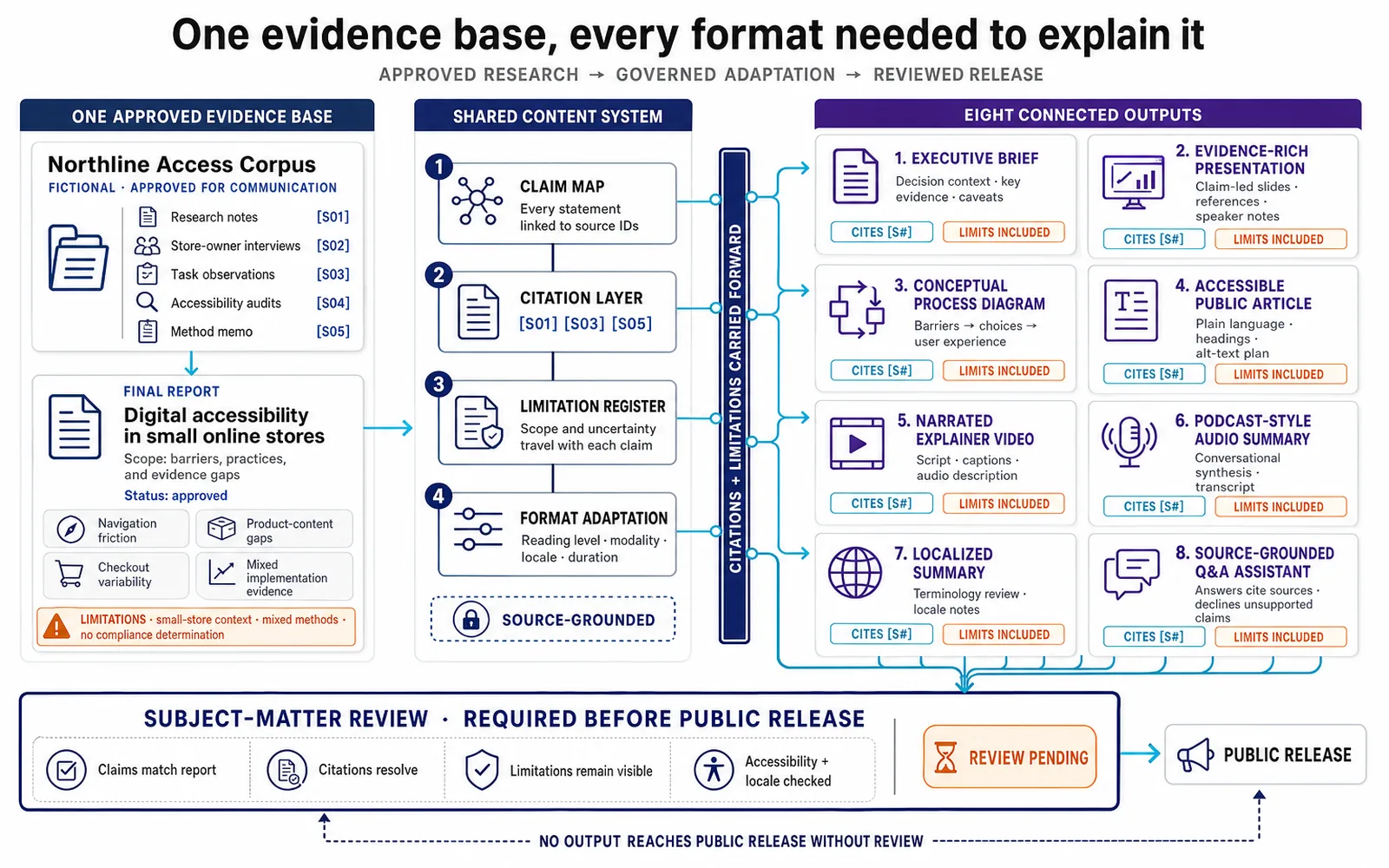
Workflow 5: Research to multi-format knowledge
- Approve the source corpus and evidence matrix.
- Write the detailed report and citation audit.
- Create an executive summary for decision-makers.
- Produce a diagram and presentation.
- Adapt the findings into an accessible article, video, and narrated audio.
- Localize the outputs.
- Build a source-grounded Smart Assistant.
- Define when the research must be refreshed.
A reusable evidence-first research prompt
Act as a research assistant. Help me organize and evaluate evidence,
but do not present unsupported statements as facts.

Research question:
[Focused question]

Purpose and audience:
[Decision, paper, report, product research, article, presentation]

Scope:
[Population, geography, time range, source types, exclusions]

Approved source material:
[Documents, URLs, transcripts, datasets, notes]

Desired output:
[Search strategy, source table, evidence matrix, synthesis, report]

Requirements:
- distinguish primary, secondary, and commentary sources;
- preserve a link or location for every extracted claim;
- separate evidence, interpretation, and recommendation;
- flag conflicting, outdated, missing, or low-confidence information;
- do not invent citations, quotations, numbers, authors, or dates;
- state when the supplied sources do not answer the question;
- identify claims that require domain-expert review;
- end with the most important unanswered questions.
Save the structure as a Smart Assistant for repeated literature scans, market updates, interview synthesis, or research-report production.
How to choose an AI model for research
There is no single best AI model for every research task.
| Research task | Useful capability |
|---|---|
| Source discovery | Web research with visible citations |
| Long-document analysis | Large context and accurate extraction |
| Evidence comparison | Structured reasoning and uncertainty |
| Fast screening | Low latency and consistent classification |
| Qualitative synthesis | Nuanced theme detection and source preservation |
| Report editing | Clear structure and audience adaptation |
| Visual explanation | Strong diagram and visual-brief generation |
Neurohelper allows users to compare leading models in one subscription rather than assuming one model should handle every stage. A deep-research model may find candidate evidence, another model may challenge the synthesis, and specialist media models can communicate the reviewed result.
Research risks and responsible use
Fabricated citations
A plausible title, journal, author list, or URL may not exist. Verify bibliographic records and open every important source.
Citation mismatch
A source may exist but not support the sentence attached to it. Confirm the exact passage, table, method, and context.
Source-quality collapse
Ten articles repeating the same press release do not equal ten independent sources. Trace claims back to origin.
Hidden selection bias
Search language, database access, publication bias, geography, and time range affect what is found. Record the boundaries.
Compression of uncertainty
Summaries often remove caveats first. Keep limitations, confidence, disagreement, and missing evidence visible in short outputs.
Sensitive data
Research materials may contain personal data, confidential interviews, health information, business secrets, unpublished results, or restricted documents. Minimize inputs, remove identifiers, follow consent and organizational policies, and use approved tools.
High-stakes conclusions
Medical, legal, financial, safety, security, and public-policy research requires qualified review and current authoritative sources. AI output alone is not sufficient evidence for consequential action.
For domain-specific boundaries and workflows, use the dedicated AI Finance Use Cases and AI Legal Use Cases sections.
Copyright and quotation
Summarize sources in your own words, use only necessary quotations, preserve attribution, and follow licensing and publication requirements. Access to a document does not grant permission to republish it.
How to measure the quality of AI-assisted research
Speed matters, but it is not the primary quality metric.
| Dimension | Review question |
|---|---|
| Traceability | Can every important claim be traced to a source? |
| Relevance | Does the evidence answer the defined question? |
| Coverage | Are important source types and competing views represented? |
| Accuracy | Are quotations, numbers, dates, and methods correct? |
| Independence | Are apparently separate sources actually independent? |
| Uncertainty | Are limitations and unknowns visible? |
| Reproducibility | Could another reviewer understand the search and selection process? |
| Usefulness | Does the output support the intended decision or learning goal? |
Test the workflow on a small known topic. Compare AI extraction and classification with manual review before using it at scale.
Common mistakes
Starting with a vague prompt
Without a focused question and scope, AI returns a polished tour of the topic rather than useful research.
Treating search summaries as sources
Search snippets and generated overviews help navigation. Cite and evaluate the underlying material.
Combining discovery and conclusion in one step
Separate finding sources, verifying them, extracting evidence, and interpreting the result. Each stage has different failure modes.
Asking for consensus too early
Consensus language can hide differences in population, method, definition, and outcome. Build the evidence matrix first.
Using an image generator for exact charts
Conceptual visuals can be generative. Statistical charts and scientific figures should come from validated data and deterministic tools.
Keeping no research log
Record queries, databases, dates, inclusion decisions, source versions, and changes. Otherwise the result becomes difficult to update or reproduce.
Publishing before citation review
A fluent report can still contain unsupported claims. Audit citations and source locations as a separate final step.
A practical 45-day adoption plan
Days 1–10: choose one repeatable research task
Select source screening, document extraction, interview coding, competitor updates, citation audits, or report adaptation. Define the expected output and quality standard.
Days 11–20: create the evidence structure
Build the source log, inclusion criteria, extraction fields, evidence matrix, and review checklist. Test several leading models on the same small corpus.
Days 21–30: add synthesis and challenge
Generate themes and conclusions, then ask another model or reviewer to identify missing evidence, contradictions, and alternative interpretations.
Days 31–40: create audience-specific outputs
Turn the approved synthesis into an executive brief, presentation, diagram, explainer, or localized version without changing the underlying claims.
Days 41–45: document and reuse
Save the workflow as a Smart Assistant, define access and review responsibilities, and record when the evidence must be refreshed.
For personal learning and study workflows, explore AI for Productivity and Wellness. For organization-wide adoption and governance, use the AI for Business guide.
Final verdict
AI can make research faster, broader, and easier to communicate.
Its value is highest when it improves the structure of the work: sharper questions, better search strategies, consistent extraction, visible contradictions, reusable evidence, clearer reports, and formats that different audiences can understand.
The model should never become an invisible source.
Keep primary evidence, traceability, uncertainty, privacy, and human review at the center. Then use Neurohelper to connect the stages that usually fragment across many tools—from deep research and long-document analysis to diagrams, presentations, video, audio, localization, and source-grounded Smart Assistants.
Frequently asked questions
How can AI be used for research?
AI can help define questions, generate search strategies, discover candidate sources, screen documents, extract comparable fields, summarize papers, analyze interviews, build evidence matrices, draft report structures, audit citations, and communicate verified findings.
What is the best AI research workflow?
Start with a focused question and explicit evidence criteria. Discover and verify sources, extract information with source locations, compare findings in an evidence matrix, separate interpretation from evidence, review uncertainty, and only then create the final report or recommendation.
Can AI perform a literature review?
AI can support searching, screening, extraction, comparison, theme organization, and drafting. The researcher remains responsible for the review method, corpus selection, source verification, interpretation, citations, and academic integrity.
Can AI find academic sources?
Research-enabled models can discover candidate papers and references. Verify that each paper exists, confirm its metadata, access the original source, and check whether it actually supports the associated claim.
How do I prevent fake AI citations?
Require stable links or identifiers, open every important source, verify author, title, venue, date, and exact supporting passage, and exclude any citation that cannot be confirmed.
Can AI analyze research data?
AI can explain data, suggest transformations, identify patterns, and help write analysis code or formulas. Exact calculations should be performed and validated with appropriate statistical, spreadsheet, or programming tools.
Is AI useful for market research?
Yes. AI can organize competitors, customer reviews, positioning, product documentation, pricing, interviews, and trend evidence. Changing facts should be verified from current primary sources and estimates should be labeled.
Can AI analyze interviews and qualitative data?
AI can assist with coding, themes, comparisons, and representative excerpts. Preserve links to original statements, protect participant privacy, validate the coding scheme, and review minority or contradictory views.
Which Neurohelper modules are useful for research?
Chat Master supports discovery, document analysis, extraction, synthesis, and writing. Image Master supports conceptual diagrams and editorial visuals. Video Master and Audio Master create explainers and narration. Smart Assistants preserve repeatable, source-grounded research workflows.
Why compare several AI models during research?
Models differ in web research, long-context handling, structured reasoning, extraction consistency, speed, and writing. Comparing models can expose assumptions and alternative interpretations, but agreement between models is not evidence by itself.
Is AI-generated research reliable?
It can be useful when sources and methods are verified. Reliability depends on the question, corpus, model, prompt, extraction accuracy, domain, review process, and whether claims remain traceable to authoritative evidence.
Can AI replace a researcher?
No. AI can reduce repetitive work and expand analysis, but it does not assume responsibility for research design, ethics, source selection, domain judgment, interpretation, or consequential conclusions.