
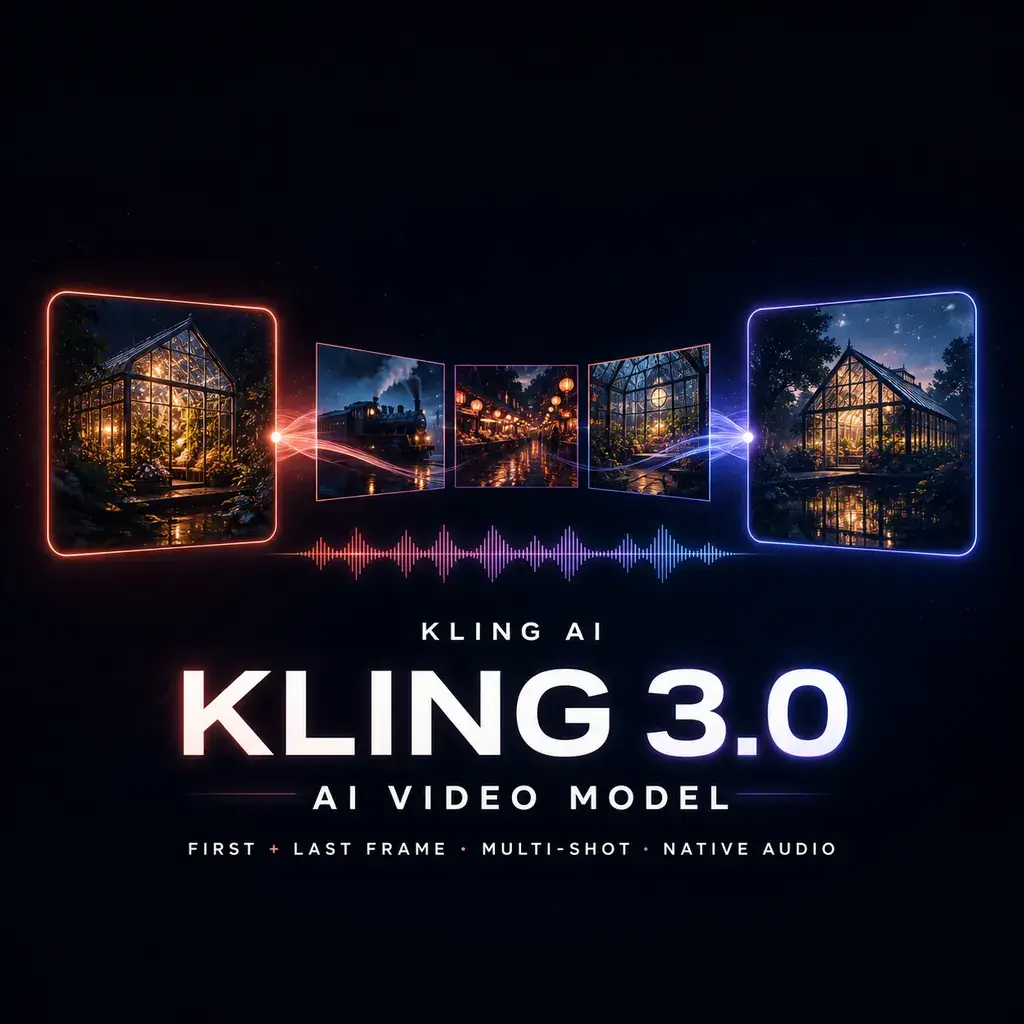
Kling 3.0 15-second stories with controlled frames, voices, and motion
Animate a required first-frame image into a polished campaign or original story. Use an optional last frame to control the destination, direct multi-shot action and dialogue, preserve important characters and lettering, and generate synchronized audiovisual scenes inside Neurohelper AI.
Kling 3.0 is available inside the same Neurohelper AI workspace as Chat Master, Image Master, Video Master, Audio Master, and Smart Assistants. Develop the idea, generate first and last frames, direct the video, and continue into voice, music, advertising, social content, or a complete creative campaign without maintaining another separate subscription.
Kling 3.0 overview
A reference-led model built for scenes that actually progress
Kling 3.0 combines a required first frame with stronger shot planning, subject consistency, native audiovisual output, dialogue control, and longer generation. Its value is not merely making an image move: the model can carry products, characters, lettering, environments, and sound through a complete 15-second idea.
Anchor the first impression
Use the first frame to establish the subject, composition, wardrobe, product details, typography, lighting, and visual language.
Plan the middle
Sequence shots, actions, reactions, dialogue turns, camera changes, and sound cues instead of asking for disconnected spectacle.
Control the destination
Add a last frame when the final packshot, character pose, campaign layout, location, or emotional resolution must land precisely.
Three practical Kling 3.0 workflows
Choose the right amount of frame control
The first frame is always required in the Neurohelper AI integration. A last frame is optional: use it only when the destination matters more than leaving the model room to compose the ending.
Let performance drive the shot
Best for dialogue, natural reactions, environmental motion, a single camera move, UGC, and scenes whose ending can remain flexible.
Lock a transformation or reveal
Useful for product films, travel campaigns, action journeys, title reveals, and stories that must finish on an approved composition.
Build progression inside one output
Assign a purpose to every shot, preserve the same subjects, and keep dialogue and sound synchronized with what changes on screen.
Three marketing cases · three creative cases
Six 15-second briefs that let Kling 3.0 show its range
The set covers product consistency, readable branding, hospitality storytelling, multi-character advertising, dynamic action, dialogue, and stylized animation. Every case begins with a required first frame; selected cases add a last frame where the ending needs tighter control.
Move from material detail to an unmistakable final packshot
Use two approved frames to protect the product geometry and wordmark while Kling plans the close-ups, movement, lighting, and synchronized sound between them.
View first-frame, last-frame, and video prompts
First frame: Premium cinematic 16:9 product photograph of completely fictional over-ear headphones named “VANTA LOOP.” The headphones stand upright inside a thin brushed-aluminum circular display ring on a dark mineral plinth. Matte graphite earcups, soft charcoal cushions, one narrow coral light seam, precise metal hinges, and the exact small wordmark “VANTA LOOP” printed once on the left earcup. Deep black studio, faint atmospheric haze, controlled reflections, product fully visible, no person, no real logo, no extra text.
Last frame: Final 16:9 hero packshot of the exact same VANTA LOOP headphones centered on the same mineral plinth, now outside the display ring and facing three-quarter toward camera. Preserve the graphite finish, coral seam, hinges, cushions, proportions, and exact readable wordmark. One restrained coral-to-blue light arc behind the product, generous negative space, no additional object, person, slogan, or logo.
Video: Use the supplied images as the exact first and last frames. Create a 15-second premium product launch film with three controlled shots. Shot 1, 0–5 seconds: slow push toward the headphones as the display ring emits a restrained moving highlight; the product remains fixed. Shot 2, 5–10 seconds: macro coverage of the hinge, cushion texture, and coral light seam, preserving every material and the VANTA LOOP wordmark. Shot 3, 10–15 seconds: pull back into the supplied final packshot while the light arc resolves behind the headphones. Native audio: quiet room tone, one precise metal adjustment click, soft cushion movement, a clean low-frequency pulse, and a short stereo tonal resolve. No exploding parts, floating pieces, liquid, hand, wearer, redesign, duplicate product, spelling change, new text, or real brand.
Sell an experience through progression, not a static room tour
The train remains the visual anchor while three controlled exterior shots move from a blue-hour welcome to a coastal sunrise.
View first-frame, last-frame, video, and negative prompts
First frame: Cinematic 16:9 campaign still of a completely fictional midnight-blue sleeper train waiting at a European coastal station during blue hour. Elegant rounded carriages, thin warm brass trim, softly lit windows, wet platform reflections, and the exact readable name “NIGHTGLASS” printed once beside the nearest door. One uniformed attendant stands beside the open door; no visible passenger face, no real railway logo, no additional readable signage.
Last frame: Cinematic 16:9 sunrise hero view of the exact same NIGHTGLASS sleeper train traveling along a coastal cliff above a calm silver sea. Preserve the midnight-blue carriages, rounded windows, brass trim, carriage count, and exact readable NIGHTGLASS name. Warm dawn light touches the train; no other vehicle, text, logo, or person.
Video: Use the supplied images as the exact opening and closing keyframes of the same fictional NIGHTGLASS sleeper train. Create a 15-second cinematic hospitality film composed of exactly three separate exterior shots. Use clean hard editorial cuts between shots; do not transform one camera position continuously into another. SHOT 1 — 0 to 4 seconds: begin from the supplied first frame at the coastal station during blue hour. Keep the train, open door, attendant, platform, architecture, windows, and camera perspective unchanged. Use only a very slow controlled push-in. The attendant remains beside the doorway and makes one small welcoming hand gesture. He does not enter the train. The door remains open. Rain falls gently and warm compartment light reflects on the wet platform. HARD CUT. SHOT 2 — 4 to 10 seconds: exterior side-tracking shot of the exact same NIGHTGLASS train moving slowly along a coastal railway during early predawn. The camera travels parallel to the train from a stable exterior position. Preserve the midnight-blue body, warm brass trim, rounded windows, warm compartment lighting, and overall carriage design. Show only the exterior of the train. The landscape moves naturally behind it. HARD CUT. SHOT 3 — 10 to 15 seconds: transition directly into a wide exterior view closely matching the supplied final frame. The same train follows the coastal curve above the calm sea as warm sunrise light reaches the carriages. Use a gentle stabilized aerial pullback while the train moves smoothly forward. Preserve the final composition and arrive exactly at the supplied last frame. Hold the final view steadily for the last 1.5 seconds. Keep the train physically solid and consistent throughout: one train only, one continuous railway, consistent travel direction, stable carriage geometry, realistic wheels, windows, reflections, and scale. Native audio: soft rain and distant station ambience in the opening, restrained wheel rhythm after the first cut, gentle coastal wind, and an elegant minimal orchestral rise at sunrise. No dialogue.
Negative prompt: interior train shot, corridor, dining compartment, breakfast scene, view through a train window, train visible through its own window, duplicate train, second train, impossible interior-exterior composite, transparent carriage, double exposure, crossfade, continuous location morph, camera passing through the train, teleporting camera, reversed travel direction, changing train design, changing carriage color, changing window shape, changing carriage count, warped railway, bent rails, floating wheels, disconnected carriages, melting metal, distorted door, closing door, attendant entering the train, disappearing person, ghost body, duplicated attendant, extra passenger, unstable face, extra limb, sudden daylight change, flickering sky, aggressive time lapse, excessive camera shake, abrupt zoom, distorted NIGHTGLASS lettering, misspelled text, new text, subtitle, real logo.
Combine readable branding, distinct speakers, and energetic coverage
A single entrance frame anchors the people and event identity while Kling builds controlled dialogue, food atmosphere, crowd sound, and a memorable campaign close.
View first-frame, video, and negative prompts
First frame: Photorealistic cinematic 16:9 opening frame at the entrance of a completely fictional evening food festival called “GLOWYARD.” The exact word “GLOWYARD” appears once in large readable warm-white capitals on an overhead arch. Three original fictional friends stand beneath it: a Black woman in a red cropped jacket on the left, an East Asian man in a forest-green overshirt in the center, and a white woman with a short silver bob and navy coat on the right. Colorful food stalls, hanging lanterns, realistic crowd depth, natural faces, no resemblance to public figures, no real restaurant logos, no other readable text.
Video: Use the supplied image as the exact first-frame reference for all three people, their faces, wardrobes, left-center-right positions, the GLOWYARD arch, lantern palette, stalls, lighting, and camera geography. Create a 15-second event campaign composed of exactly three shots with clean hard editorial cuts. Do not morph one camera position into another. SHOT 1 — 0 to 5 seconds: remain in the supplied wide composition. Use a very slow stabilized push-in. All three friends stay beneath the arch and make only subtle natural head turns and small smiles; nobody walks or speaks yet. Keep GLOWYARD readable. HARD CUT. SHOT 2 — 5 to 11 seconds: stable medium two-shot from the same side of the camera axis, showing the woman in red and the man in green. The woman in red asks clearly, “Noodles first?” She finishes and closes her mouth. After one short beat, the man in green replies, “Only if we get dumplings too.” The woman with the silver bob remains silent at the edge of frame and reacts with a smile. HARD CUT. SHOT 3 — 11 to 15 seconds: return to a wide view close to the opening camera geography. All three turn toward the market and take no more than three slow steps together while the camera remains stable; nobody speaks. Finish with all three identities visible and the GLOWYARD arch readable behind them. Native audio: two distinct natural voices with no overlap, restrained crowd ambience, soft grill sizzle, one distant bicycle bell, gentle lantern movement, and a short upbeat percussion resolve.
Negative prompt: identity swap, face drift, changing ethnicity, changing age, wardrobe change, speaker confusion, voice swap, overlapping dialogue, silent character moving lips, inaccurate lip sync, duplicated friend, extra friend, missing character, extra limb, deformed hand, exaggerated gesture, running, dancing, fast crowd crossing foreground, camera crossing the 180-degree axis, continuous camera morph, teleporting camera, location change, arch deformation, unreadable GLOWYARD, misspelled text, additional text, subtitle, real logo, food close-up, food deformation, flicker, time jump, aggressive zoom, shaky camera.
Build a complete pursuit inside one controlled location
One opening frame anchors the protagonist, creature, walkway, and destination while Kling directs a short physically believable journey without forcing an incompatible endpoint.
View first-frame, video, and negative prompts
First frame: Cinematic photorealistic 16:9 night scene inside a vast abandoned botanical glasshouse during rain. One original fictional female botanist in a dark teal field coat stands on a straight wet iron walkway, holding a small brass compass. A hand-sized clockwork moth with copper wings and one blue glass light hovers beside her shoulder. At the far end of the same visible walkway, include one small dormant brass signal receiver mounted securely to the railing, with a single dark blue glass lens. Dense tropical plants, broken roof panes, moonlight, rain streaks, realistic materials, all key elements visible within one coherent level, no text, logo, weapon, or public-figure resemblance.
Video: Use the supplied image as the exact first-frame reference for the botanist, her face and dark teal coat, brass compass, hand-sized clockwork moth, straight walkway, signal receiver, glasshouse architecture, plants, rain, lighting, and camera geography. Create a 15-second cinematic sequence composed of exactly three shots with clean hard editorial cuts. Keep the entire story on the same walkway and same floor of the glasshouse. SHOT 1 — 0 to 5 seconds: begin in the supplied wide composition. The botanist keeps her feet planted, lowers her eyes to the compass, and tilts it slightly. The compass needle rotates once, the moth’s blue light pulses once, and she looks toward the visible receiver. Use only a restrained stabilized push-in. HARD CUT. SHOT 2 — 5 to 10 seconds: side-on stabilized tracking shot along the same straight walkway. The botanist walks briskly only three or four steps toward the receiver while the moth flies beside her shoulder at constant hand-sized scale. No stairs, turn, jump, obstacle, or floor change. HARD CUT. SHOT 3 — 10 to 15 seconds: stable medium view at the far end of the same walkway. The botanist stops beside the existing receiver without touching it. The moth makes one small circle, lands gently on the receiver, and its blue light activates the matching blue lens with one restrained pulse. The botanist watches and remains still. Hold the resolved composition for the final 1.5 seconds. Native audio: rain on glass, three or four measured boots on iron, quiet breathing, precise mechanical wing clicks, subtle compass vibration, distant thunder, and one spatial signal tone. No dialogue.
Negative prompt: last-frame interpolation, location change, exterior roof, sunrise, daylight transition, different floor, stair climbing, ladder climbing, continuous camera morph, camera passing through glass, camera teleportation within a shot, running, sprinting, jumping, falling, acrobatics, collision, collapsing walkway, breaking glass, plant grabbing character, duplicate botanist, duplicate moth, missing moth, giant moth, changing moth scale, biological insect, face drift, wardrobe change, extra limb, deformed hand, compass deformation, receiver deformation, moving receiver, architecture redesign, different glasshouse, explosion, lightning strike, creature transformation, flicker, abrupt style change, text, subtitle, logo, speech.
Direct shot-reverse-shot coverage without losing who speaks
A compact mystery scene tests identity, eyelines, pauses, distinct voices, room tone, and clear multi-character coreference.
View first-frame, video, and negative prompts
First frame: Cinematic photorealistic 16:9 opening frame inside a nearly empty late-night diner. Three entirely fictional adults sit around table seven: a middle-aged female waitress in a pale blue uniform stands on the left, a young male violinist in a burgundy jacket sits in the center, and an older female night-bus driver in a charcoal coat sits on the right. One small brass key lies clearly visible beside a white coffee cup. Warm tungsten light, rain on windows, wall clock in background, natural faces with no resemblance to public figures, no readable menu, logo, or extra customer.
Video: Use the supplied image as the exact first-frame reference for the waitress on the left, violinist in the center, bus driver on the right, their faces and clothes, the table, white cup, brass key, wall clock, lighting, seating, eyelines, and camera axis. Create a 15-second dialogue scene with exactly four short shots and clean hard cuts. Keep every line complete, sequential, and non-overlapping. Only the named speaker moves their lips during each line; the other two remain silent with closed mouths and subtle listening reactions. SHOT 1 — 0 to 4 seconds: stable wide three-person composition close to the supplied frame. The waitress glances down at the key without touching it and says quietly, “The key was under your cup.” Her hands remain still. HARD CUT. SHOT 2 — 4 to 8 seconds: stable medium shot of the violinist from the same camera axis. Both hands remain resting visibly on the table. He looks at the waitress and replies, “I never touched it.” HARD CUT. SHOT 3 — 8 to 12 seconds: stable medium shot of the bus driver. She briefly shifts her eyes toward the wall clock, looks back to the others, and says, “Then why did it stop at seven?” HARD CUT. SHOT 4 — 12 to 15 seconds: return to the original wide three-person geography. Nobody speaks or changes position. The overhead light dims once for less than half a second; one soft lock click sounds off screen; all three react only with their eyes. The brass key, cup, and clock remain completely still. Native audio: three distinct close voices, gentle rain, low refrigerator hum, one brief light buzz, and one restrained lock click. No music or narrator.
Negative prompt: overlapping speech, simultaneous lip movement, silent character speaking, speaker confusion, voice swap, extra dialogue, paraphrased dialogue, narrator, subtitle, captions, text overlay, duplicated person, missing person, extra customer, identity swap, face drift, age change, wardrobe change, seating change, eyeline reversal, camera crossing the 180-degree axis, continuous camera morph, handheld shake, exaggerated expression, shouting, laughing, touching the key, moving key, floating key, moving cup, drinking, eating, deformed hand, extra fingers, clock deformation, changing clock time, supernatural creature, apparition, flickering throughout, logo, readable menu.
Preserve a tactile art direction through a complete miniature story
One opening frame defines the handmade materials while controlled close-ups complete the repair without forcing a new exterior composition.
View first-frame, video, and negative prompts
First frame: Handcrafted cinematic 16:9 stop-motion scene inside a tiny hilltop weather observatory made from wool felt, painted wood, brass, paper, and stitched fabric. One original elderly felt astronomer with round teal glasses, a mustard waistcoat, white yarn hair, and a navy cap stands beside a tabletop weather machine: three brass dials, a glass dome containing one small gray felt cloud, and a red handwheel. Night outside the round window, tactile fingerprints and stitching visible, no text, logo, or known character resemblance.
Video: Use the supplied image as the exact first-frame reference for the same felt astronomer, his glasses and wardrobe, weather machine, three dials, glass dome, gray cloud, red handwheel, observatory interior, round window, scale, and handcrafted material language. Create a 15-second stop-motion story composed of exactly four shots with clean hard cuts and intentionally stepped frame-by-frame movement. Keep every shot inside the same observatory. SHOT 1 — 0 to 4 seconds: begin in the supplied wide composition. The gray felt cloud bumps gently against the inside of the glass dome exactly once; only the left brass dial vibrates. The astronomer turns his head slightly toward the machine while his body and hands remain still. HARD CUT. SHOT 2 — 4 to 8 seconds: stable close-up of the existing red handwheel and the astronomer’s right felt hand. His right hand rotates the handwheel one quarter-turn clockwise and stops; his left hand remains outside the frame. No tool and no second adjustment. HARD CUT. SHOT 3 — 8 to 11 seconds: stable close-up of the same glass dome with no human hands visible. The cloud gradually changes from gray felt to white felt, the vibrating dial settles, and the machine releases one small cotton-like puff. The dome and machine remain fixed. HARD CUT. SHOT 4 — 11 to 15 seconds: return to a wide composition close to the supplied opening camera geography. The repaired machine is still in the same place, the white cloud remains inside the dome, and exactly three small paper raindrops fall inside the dome and stop. Soft dawn light gradually appears through the round window. The astronomer makes one small relieved nod and otherwise remains still. Hold the final interior composition for the last second. Native audio: soft felt movement, one wooden handwheel creak, two restrained brass clicks, paper rustle, one soft puff, three delicate paper-rain taps, and a short playful chamber-music resolve. No dialogue.
Negative prompt: last-frame interpolation, exterior shot, outdoor garden, location change, continuous interior-to-exterior morph, melting felt, liquid fabric, photoreal human skin, realistic human hair, smooth CGI motion, style change, machine redesign, extra dial, missing dial, detached handwheel, spinning handwheel, repeated adjustment, extra tool, extra limb, extra finger, duplicated astronomer, missing astronomer, spinning head, distorted glasses, wardrobe change, giant cloud, duplicate cloud, cloud escaping dome, broken glass dome, rain outside dome, flood, storm, lightning, explosion, uncontrolled rain, camera shake, fast zoom, text, subtitle, logo, known character.
How to prompt Kling 3.0
Treat 15 seconds as a sequence, not one oversized instruction
Define what the first frame locks, divide the visible events into a clear timeline, and connect dialogue and sound to specific shots. If a last frame is supplied, explain how the scene should arrive there without redesigning either endpoint.
Protect the anchors
Name the faces, product geometry, wardrobe, lettering, architecture, palette, and camera geography that must remain consistent with the first frame.
Give every shot a job
Specify the order, approximate timing, framing, action, reaction, transition, and final state instead of stacking unrelated cinematic adjectives.
Direct voices and sound
Assign every spoken line to a named character and place ambience, Foley, effects, music, and silence beside the visible event that creates them.
The first and last images should depict a physically and narratively reachable transition. If they disagree on identity, product design, location, lighting, or camera logic, use only the first frame or regenerate a compatible endpoint.
Practical model selection
Where Kling 3.0 is especially useful
Strong uses
- 15-second product films, hospitality campaigns, event advertising, and branded stories;
- multi-shot sequences with a clear beginning, progression, and approved ending;
- two-, three-, or multi-character scenes with assigned dialogue and reactions;
- action, camera coverage, stylized animation, character performance, and environmental motion;
- first-frame animation and first-to-last-frame transitions;
- native dialogue, ambience, Foley, effects, music, and multilingual performances.
Review carefully when
- first and last frames cannot be connected without redesigning the subject or world;
- small legal copy, packaging text, or interface details must remain pixel-perfect;
- the brief asks for too many locations, people, actions, and spoken lines in 15 seconds;
- hands perform intricate assembly, opening, pouring, or object-transfer physics;
- real people, public figures, news-like footage, or potentially deceptive media are involved;
- commercial claims require factual, medical, financial, or legal approval.
Kling 3.0 specifications
Compact model reference
The page describes the first-frame and optional last-frame workflow currently available in Neurohelper AI. Broader Kling controls can vary by product and integration. Capabilities were checked against the official Kling VIDEO 3.0 Model User Guide. Last reviewed August 22, 2026.
Frequently asked questions
Kling 3.0 FAQ
What is Kling 3.0?
Kling 3.0 is an AI video model designed for longer audiovisual generation, stronger multi-shot narratives, improved subject consistency, dialogue, sound, and controlled reference-led workflows.
Does Kling 3.0 require a first-frame image?
Yes in the mode currently available through Neurohelper AI. The first frame establishes the opening composition, subjects, products, wardrobe, location, lighting, and important text.
Is a last-frame image required?
No. Add one when the scene must finish on a specific packshot, pose, environment, title, or story resolution. Use only the first frame when performance and natural development matter more than an exact endpoint.
How long can a Kling 3.0 video be?
Kling 3.0 supports generation up to 15 seconds, which is enough for a compact product film, multi-shot campaign, dialogue exchange, action beat, or miniature narrative arc.
Can Kling 3.0 generate native dialogue and sound?
Yes when native-audio generation is enabled. The model can coordinate dialogue, ambience, Foley, effects, and music with visible actions. Assign every line to a clearly identified character.
Is Kling 3.0 useful for advertising?
Yes. Product consistency, readable reference text, longer multi-shot output, dialogue, and synchronized audio make it useful for product launches, hospitality, event campaigns, fashion, e-commerce, and social advertising.
Is Kling 3.0 available in Neurohelper AI?
Yes. Kling 3.0 is available through Video Master alongside other video, image, chat, voice, sound, and music models. Available settings and usage limits depend on the selected plan and active integration.
From approved frames to a complete 15-second scene
Build advertising and original stories with picture, performance, and sound.
Create the first frame in Image Master, optionally design the ending, generate the video in Video Master, and continue into voice, music, editing, social content, or a complete campaign inside Neurohelper AI.