
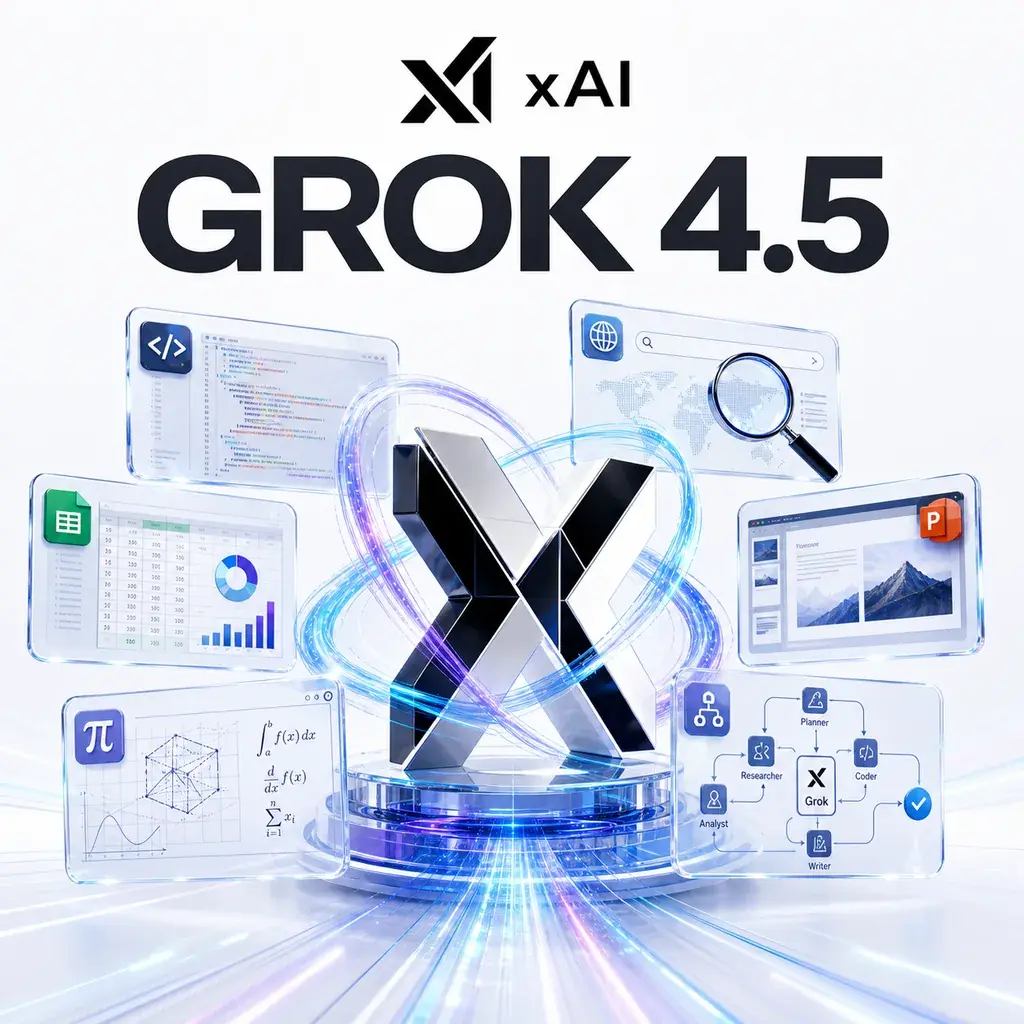
Grok 4.5 Engineering intelligence at working speed
Solve difficult coding, research, business, document, and operational tasks with a model designed for efficient multi-step reasoning—inside the multi-model Neurohelper AI workspace.
Working context
Grok 4.5 connects evidence, implementation, validation, and operational safety instead of stopping at a plausible diagnosis.
Grok 4.5 is available in the same Neurohelper AI subscription as GPT-5.6, Claude, Gemini, Qwen, DeepSeek, and specialist image, video, and audio models. Start with Grok for engineering or complex working tasks, then switch models when another perspective or media capability fits the next step better.
Grok 4.5 overview
What is Grok 4.5?
Grok 4.5 is xAI's flagship reasoning model for coding, agentic tasks, and knowledge work. Its practical appeal is the combination of strong engineering capability, a large working context, configurable reasoning, and fast delivery—useful when a task requires several connected steps rather than one isolated answer.
Built for real engineering
Use it to inspect a system, understand constraints, plan a change, write or repair code, add tests, and explain the trade-offs to the team.
Efficient multi-step reasoning
Grok 4.5 is designed to spend reasoning where it improves the result without turning every substantial task into an unnecessarily slow conversation.
Beyond coding
The same capabilities apply to research, financial models, analytical documents, presentations, operating plans, and decision-ready business work.
Best Grok 4.5 use cases
Use Grok when the answer must survive execution
The model is most useful when you need more than ideas: a traceable diagnosis, a working artifact, a tested plan, or a recommendation that accounts for real constraints.
Move from bug report to safe fix
Connect code, logs, traces, architecture, requirements, and incident history. Produce a diagnosis, minimal change, tests, rollout plan, monitoring, and rollback conditions.
Build a current intelligence brief
Organize reports, source material, market signals, and supplied evidence into claims, contradictions, confidence levels, implications, and questions that still require verification.
Create decision-ready working documents
Turn financial assumptions, operating data, meeting notes, risks, and constraints into models, action plans, executive memos, presentation structures, and accountable next steps.
Design a measurable campaign system
Translate research and product evidence into positioning, message architecture, campaign briefs, UGC concepts, content plans, channel variants, and a measurement framework.
Grok 4.5 prompts
Four prompts built around finished work
Give Grok the evidence, define the decision or artifact, specify safety checks, and make the model expose assumptions. Switch between practical examples below.
Investigate the production failure using the repository, deployment diff, service logs, traces, metrics screenshots, architecture notes, and incident timeline.
Reconstruct the causal chain before proposing a fix. Separate confirmed evidence from hypotheses. Recommend the smallest safe change, provide the patch, regression tests, monitoring queries, staged rollout, rollback triggers, and a short explanation for non-engineering stakeholders. Do not modify unrelated code.
- Evidence-backed root cause
- Smallest safe implementation
- Regression and monitoring plan
- Rollout and rollback conditions
Useful when a plausible answer is not enough and the fix must work safely in production.
Create a decision brief from the supplied market reports, competitor pages, customer interviews, pricing data, regulatory notes, and internal sales feedback.
Build a claim table with source, date, evidence, confidence, and business implication. Separate durable market structure from recent signals. Identify contradictions and missing evidence. Compare three strategic options, recommend one, and design the cheapest experiment that could disprove the recommendation within 30 days.
- Claims linked to evidence
- Recent signals separated from durable facts
- Three options compared consistently
- Low-cost disconfirmation test
Strong for competitor analysis, category research, partnerships, and go-to-market decisions.
Build a three-year operating model from the historical statements, sales pipeline, pricing assumptions, hiring plan, retention data, and management notes.
Create base, upside, and downside scenarios. Keep assumptions separate from formulas, explain every major driver, add consistency checks, identify the variables with the greatest effect on cash runway, and produce an executive summary with risks and decisions. Flag missing data rather than silently inventing it.
- Auditable assumptions and formulas
- Three operating scenarios
- Cash-runway sensitivity
- Decision-focused executive summary
Useful for planning and scenario exploration, with qualified human review for financial decisions.
Turn the product brief, customer language, reviews, competitor campaigns, brand rules, approved claims, channel requirements, and performance data into one campaign operating plan.
Define positioning, message hierarchy, three creative territories, landing-page structure, five UGC concepts, social variations, video briefs, production dependencies, review gates, and measurement. Connect each idea to customer evidence and mark claims that require legal or product approval.
- Research-backed messaging system
- Creative and UGC production briefs
- Review gates and dependencies
- Channel measurement framework
Ideal when strategy, creative production, and campaign operations must stay connected.
Connected Neurohelper AI workflow
From investigation to a complete business deliverable
Use Grok 4.5 for the demanding analytical or engineering core, another frontier model for review, and specialist models for the visual and media production that follows.
Investigate
Grok 4.5 connects source material, code, data, constraints, and the real task.
Challenge
GPT-5.6 Sol, Claude Sonnet, or Gemini Pro pressure-tests assumptions and gaps.
Visualize
GPT Image 2 or Nano Banana turns the approved direction into diagrams, ads, or campaign visuals.
Produce
Seedance, Kling, voice, and music models complete videos, explainers, and social assets.
Grok 4.5 alternatives
Choose the model that matches the work
Grok is compelling for engineering and tool-oriented knowledge work. Other frontier models may fit better when the task emphasizes a different writing style, multimodal source mix, or reasoning profile.
Grok 4.5
Choose it for coding, incident analysis, agentic work, technical plans, structured business artifacts, and difficult tasks that must move from reasoning into execution.
Claude Sonnet or GPT-5.6 Sol
Compare them when long-form explanation, editorial behavior, careful document work, or a second independent reasoning profile matters most.
Gemini 3.1 Pro
Use Gemini Pro when the problem is centered on combining PDFs, images, video, audio, text, and code in one large multimodal analysis.
Practical model selection
When Grok 4.5 is the right choice
Use Grok 4.5 when
- the task joins reasoning, tools, code, or working artifacts;
- you need a diagnosis and an executable next step;
- a large context must stay coherent across several stages;
- speed matters but a lightweight answer is insufficient;
- the output needs tests, checks, scenarios, or review gates.
Choose another model when
- the job is a simple fast conversation or rewrite;
- audio, video, or finished image generation is the primary task;
- another provider's writing style consistently fits your audience better;
- the analysis depends on current information but search is unavailable;
- a consequential result cannot receive qualified human review.
Compact Grok 4.5 guide
Useful facts without the API overload
These official specifications describe the current Grok 4.5 release. Features exposed in Neurohelper AI and usage limits depend on the selected plan and current product configuration.
Verified against the official SpaceXAI model documentation and Grok 4.5 launch announcement. Last reviewed August 7, 2026.
Frequently asked questions
Grok 4.5 FAQ
What is Grok 4.5 best for?
Grok 4.5 is designed for coding, agentic tasks, engineering work, research, complex documents, spreadsheets, presentations, and other knowledge work where reasoning must lead to a usable result.
What is the Grok 4.5 context window?
The official SpaceXAI model documentation lists a 500K-token context window. Large context helps with substantial projects, but relevant source selection and clear instructions still improve results.
Is Grok 4.5 good for coding?
Yes. xAI positions coding and real-world engineering as central Grok 4.5 strengths, including multi-step software work and end-to-end application building.
Can Grok 4.5 analyze current events?
Not from the base model alone. SpaceXAI states that current information requires search tools such as web or X search. Without them, verify time-sensitive claims separately.
Should I choose Grok 4.5, Claude Sonnet, or GPT-5.6 Sol?
Choose Grok for engineering and execution-heavy tasks. Compare Claude Sonnet for careful document and writing work, and GPT-5.6 Sol for high-consequence reasoning and broad professional workflows. Neurohelper AI lets you switch without maintaining separate subscriptions.
Is Grok 4.5 available in Neurohelper AI?
Yes. Grok 4.5 is available alongside GPT-5.6, Claude, Gemini, Qwen, DeepSeek, and creative AI models. Availability and usage limits depend on the selected Neurohelper AI plan.
One Neurohelper AI subscription, many models
Use Grok for the difficult working core. Use specialists for what comes next.
Investigate a system, build a plan, analyze a market, or structure a campaign with Grok 4.5, then continue into second-model review, image generation, video, voice, and music inside Neurohelper AI.